
News & Insights
IGU Glass: How Insulated Glass Units Are Manufactured
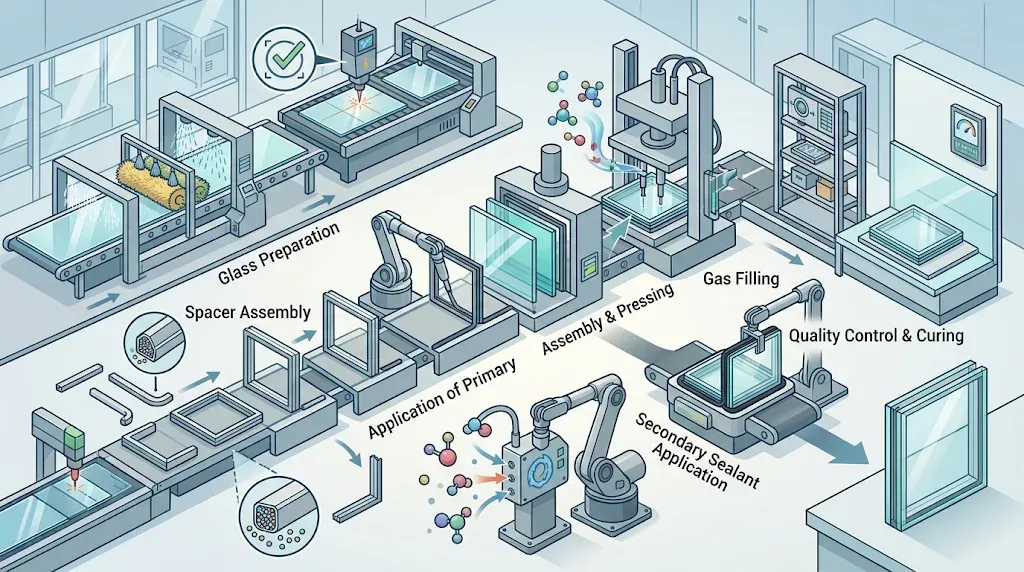
Insulated Glass Units (IGUs), commonly known as double glazing, are widely used in modern commercial buildings, residential windows, and glass curtain wall systems. By combining two or more glass panes with a sealed cavity, IGU glass helps improve thermal insulation, reduce heat transfer, and enhance indoor comfort.
However, the performance of an insulated glass unit depends not only on the glass itself but also on the quality of its spacer system, desiccant, gas filling, and edge sealing.
At Tianhou Glass, we understand that consistent manufacturing quality is essential for architectural glass applications. Here is how insulated glass units are manufactured.
1. Glass Selection and Cutting
The manufacturing process begins with selecting suitable glass according to project requirements.
Common options include:
- Clear float glass
- Ultra-clear glass
- Tempered glass
- Laminated glass
- Low-E coated glass
- Tinted glass
The selected glass is cut to the required dimensions using precision glass cutting equipment. For architectural projects, accurate dimensions are particularly important because even small deviations can affect the final assembly and installation.
Depending on the application, glass may also undergo edge grinding, drilling, or other processing before entering the next production stage.
2. Glass Washing and Drying
After cutting and processing, the glass panes are thoroughly washed and dried.
This stage removes dust, cutting residues, fingerprints, and other contaminants from the glass surfaces.
Clean glass is essential for reliable sealant adhesion. Any remaining contamination around the sealing area may compromise the edge seal and affect the long-term durability of the IGU.
3. Spacer Preparation and Desiccant Filling
The spacer separates the glass panes and determines the width of the insulating cavity.
Common spacer materials include:
- Aluminum spacers
- Stainless steel spacers
- Warm-edge spacers
- Thermoplastic spacers
A desiccant, commonly molecular sieve, is incorporated into the spacer system to absorb residual moisture inside the sealed cavity.
Proper spacer preparation and moisture control help reduce the risk of internal condensation and fogging.
4. Primary Sealing and Glass Assembly
A primary sealant, typically polyisobutylene (PIB or butyl), is applied to the spacer.
The prepared spacer is then positioned between the glass panes, and the assembly is pressed together to form the insulated glass unit.
For double-sealed IGUs, the primary seal plays an important role in limiting moisture penetration and gas loss.
Accurate alignment and consistent pressure are important during this process to ensure reliable bonding between the glass and spacer.
5. Argon Gas Filling
For projects requiring enhanced thermal performance, the cavity can be filled with argon gas instead of ordinary dry air.
Argon is commonly used because its lower thermal conductivity helps reduce heat transfer through the cavity.
The actual thermal performance depends on several factors, including:
- Glass thickness and configuration
- Cavity width
- Gas type and concentration
- Low-E coating properties
- Spacer and edge-seal design
Not every IGU requires gas filling. The appropriate configuration should be selected according to the building design and performance requirements.
6. Secondary Sealing and Final Inspection
After assembly and gas filling, a secondary sealant is applied around the perimeter.
Common secondary sealants include silicone, polysulfide, and polyurethane.
The secondary seal provides additional protection against moisture penetration and helps maintain the structural integrity of the insulated glass unit.
Before delivery, finished IGUs should undergo appropriate quality inspections, including:
- Glass dimensions and thickness
- Surface appearance and cleanliness
- Spacer alignment
- Edge-seal continuity
- Gas concentration, where applicable
- Overall assembly quality
Relevant performance standards include EN 1279 in Europe and ASTM E2190 in the United States. The applicable requirements depend on the destination market and project specifications.
How Tianhou Glass Supports Architectural IGU Projects
As an architectural glass manufacturer based in Zhuhai, Guangdong, Guangdong Tianhou Glass Engineering Co., Ltd. provides glass processing solutions for commercial buildings, residential developments, and architectural engineering projects.
With approximately 20,000 square meters of manufacturing facilities, Tianhou Glass supports different architectural glass configurations, including tempered glass, laminated glass, Low-E glass, and insulated glass.
For projects involving glass curtain walls, commercial facades, and energy-efficient windows, we consider several important factors:
- Selecting suitable glass combinations for project requirements.
- Matching glass thickness and cavity configurations to engineering specifications.
- Maintaining consistent processing quality across production batches.
- Controlling edge sealing and assembly quality.
- Supporting customized glass dimensions and processing requirements.
For example, in a commercial curtain wall project, an IGU may combine an external Low-E tempered glass pane with an internal glass pane to balance solar control, daylight transmission, and thermal insulation.
The final configuration must be determined through project-specific calculations and engineering requirements.
Conclusion
IGU glass manufacturing involves much more than simply placing two glass panes together. Every stage, from glass selection and washing to spacer preparation, gas filling, and edge sealing, contributes to the final product’s performance and durability.
For architects, contractors, and glass distributors, choosing an experienced insulated glass manufacturer is an important step toward achieving reliable building envelope performance.
Tianhou Glass provides customized architectural glass processing solutions for international projects, helping customers source insulated glass and other engineered glass products directly from a professional glass factory in China.
If you are looking for an IGU glass manufacturer for your next architectural project, contact Tianhou Glass to discuss your glass specifications and production requirements.