
News & Insights
Double Silver Low-E Glass: Performance, Applications and Benefits
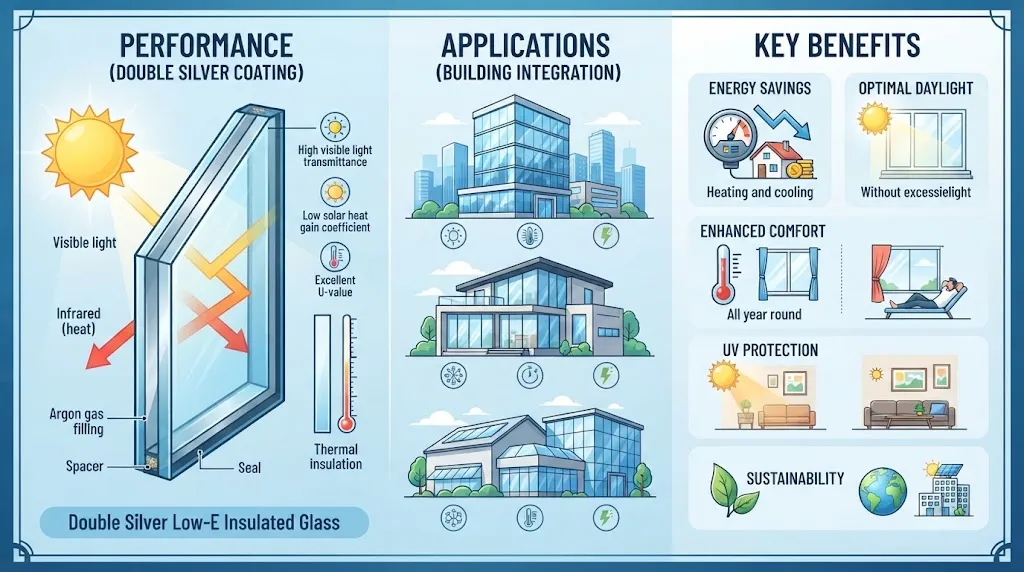
Modern buildings require glass that does more than provide transparency. Architects and developers increasingly look for glazing solutions that balance natural daylight, solar heat control, thermal insulation and architectural appearance.
Double Silver Low-E Glass is an advanced coated glass solution designed to meet these requirements. With its multiple silver-based coating layers, it offers improved solar control while maintaining useful levels of visible light transmission.
In this article, Tianhou Glass explains how double silver Low-E glass works, its key performance characteristics and where it is most suitable for modern construction projects.
1. What Is Double Silver Low-E Glass?
Double Silver Low-E Glass is a type of soft-coated low-emissivity glass that uses two functional silver layers within a multilayer coating structure.
These silver layers work together with dielectric and protective layers to selectively control different wavelengths of solar energy.
The coating provides two important functions:
- Solar Control: Reduces the transmission of unwanted solar heat, particularly near-infrared radiation.
- Thermal Insulation: Reduces radiative heat transfer through the glazing system.
Compared with conventional single-silver Low-E glass, double silver coatings generally provide better spectral selectivity, allowing buildings to receive natural daylight while reducing excessive solar heat gain.
The actual performance depends on the specific coating design and glass configuration.
2. Key Performance Characteristics
Double Silver Low-E Glass is particularly valuable for projects where energy efficiency and daylight quality must be considered together.
Solar Heat Gain Control
The coating reduces the amount of solar energy entering a building. This can help limit indoor temperature increases and reduce the cooling load during hot weather.
Natural Light Transmission
Double silver coatings are designed to balance solar protection with visible light transmission. This allows architects to achieve effective daylighting without relying entirely on heavily tinted or dark reflective glass.
Thermal Insulation
When incorporated into an insulating glass unit (IGU), Low-E coatings reduce radiative heat transfer across the sealed cavity. Combined with an appropriate spacer system and air or argon filling, they can improve the overall thermal performance of the glazing.
Energy Efficiency
By controlling solar heat gain and reducing unwanted heat transfer, double silver Low-E glass can contribute to lower heating and cooling energy consumption.
Actual energy savings depend on building orientation, climate, window-to-wall ratio, shading, HVAC systems and the complete glazing specification.
3. Double Silver Low-E Glass vs. Single Silver Low-E Glass
The main difference lies in the coating structure and its ability to selectively control solar radiation.
| Performance | Single Silver Low-E | Double Silver Low-E |
|---|---|---|
| Silver layers | One | Two |
| Solar control | Standard | Generally stronger |
| Spectral selectivity | Good | Generally higher |
| Visible light balance | Depends on coating | Often more favorable |
| Thermal performance | Good | Generally improved |
| Typical applications | Residential and commercial buildings | High-performance commercial and architectural projects |
It is important to understand that double silver does not automatically mean better performance in every application. The final selection should consider visible light transmittance (VLT), solar heat gain coefficient (SHGC), U-value and the required architectural appearance.
4. Common Applications of Double Silver Low-E Glass
Commercial Office Buildings
Large office buildings often feature extensive glass facades. Double silver Low-E glass helps control solar heat gain while maintaining a comfortable indoor environment and attractive exterior appearance.
Shopping Malls and Commercial Complexes
Shopping malls require sufficient natural daylight and effective temperature control. High-performance Low-E insulating glass can help balance these requirements.
High-Rise Residential Buildings
For high-rise residential projects, double silver Low-E glass can improve indoor thermal comfort, reduce unwanted solar heat and support energy-efficient building design.
Hotels and Public Buildings
Hotels, transportation facilities and public buildings can benefit from the combination of daylight, solar protection and modern architectural aesthetics.
5. How to Choose the Right Double Silver Low-E Glass
Selecting the right product requires more than simply specifying a double silver coating.
Project developers, architects and glass contractors should evaluate several technical factors:
- Visible Light Transmittance (VLT): Determines how much natural daylight passes through the glass.
- Solar Heat Gain Coefficient (SHGC): Measures the fraction of incident solar radiation that enters a building as heat.
- U-Value: Indicates the rate of heat transfer through the glazing system. Lower values generally indicate better thermal insulation.
- Glass Configuration: Consider glass thickness, cavity width, air or argon filling, and whether laminated or tempered glass is required.
- Coating Position: The coating surface must be selected according to the intended solar-control and thermal-performance requirements.
- Safety and Processing Requirements: Consider wind load, impact resistance, heat treatment, edge processing and applicable building regulations.
For reliable specifications, performance should be calculated or tested for the complete insulating glass configuration rather than judged by the coating type alone.
6. Tianhou Glass: Architectural Glass Processing Solutions
Guangdong Tianhou Glass Engineering Co., Ltd. is an architectural and safety glass manufacturer based in Zhuhai, Guangdong, China.
Founded in 2011, Tianhou Glass operates a manufacturing facility of approximately 20,000 square meters, providing glass processing and engineering solutions for architectural and commercial construction projects.
Our product capabilities include:
- Tempered Glass
- Laminated Glass
- Insulating Glass
- Low-E Glass
- Curtain Wall Glass
- Fire-Rated Glass
- Bulletproof Glass
- Customized Architectural Glass
For projects requiring double silver Low-E glass, Tianhou Glass can support product selection and glass processing based on project drawings, technical specifications and performance requirements.
Our experience in architectural glass projects, including public buildings, transportation facilities, educational buildings and commercial developments in the Greater Bay Area, provides a practical foundation for supporting different construction requirements.
Each project requires an appropriate balance between energy efficiency, safety, appearance and installation conditions.
7. Conclusion
Double Silver Low-E Glass is an effective solution for modern buildings that require improved solar control, thermal performance and natural daylight.
Its two silver coating layers provide enhanced spectral selectivity compared with many conventional single-silver products, making it particularly suitable for commercial buildings, curtain walls, high-rise residential projects and large public facilities.
However, the best glazing solution depends on the complete glass configuration and local climate conditions.
Tianhou Glass provides architectural glass processing solutions for international construction projects. Whether you need Low-E insulating glass, tempered glass, laminated glass or customized curtain wall glass, our team can help evaluate suitable specifications for your project.
Contact Tianhou Glass to discuss your architectural glass requirements and request a project quotation.