
News & Insights
How Carbon Reduction Goals Are Affecting Architectural Glass Selection
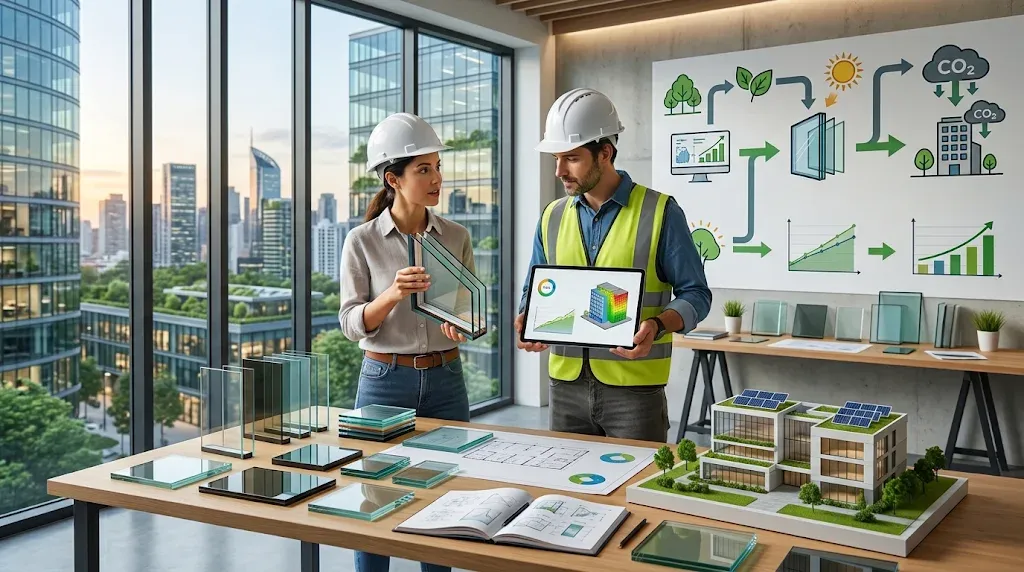
Carbon reduction has become an important consideration in modern architectural design. As governments, developers and construction companies pursue sustainability targets, building materials are being evaluated not only for their performance and appearance but also for their environmental impact.
Architectural glass is particularly important because it influences both building energy consumption and the carbon footprint of construction materials. As a result, architects and contractors are paying more attention to glass specifications, manufacturing processes and long-term building performance.
For glass manufacturers and project suppliers, understanding these changes is essential.
1. From Energy Efficiency to Whole-Life Carbon Reduction
Traditionally, architectural glass selection focused on safety, transparency, thermal insulation and aesthetics. Today, carbon reduction requires a broader approach.
Two important concepts are involved:
- Operational Carbon: Carbon emissions generated during a building’s operation, particularly through heating, cooling and lighting.
- Embodied Carbon: Carbon emissions associated with raw material extraction, manufacturing, transportation, installation and eventual replacement.
Choosing high-performance glass can help reduce operational energy consumption. However, manufacturing more complex glass products may also involve additional processing and material-related emissions.
Therefore, selecting architectural glass requires balancing operational energy savings against embodied carbon throughout the building’s life cycle.
2. Low-E Glass Is Becoming More Important
Low-E glass has become an important solution for energy-efficient buildings.
Its specially designed coating helps control heat transfer and solar radiation while maintaining natural daylight.
Depending on the coating configuration and climate, Low-E glass can provide several advantages:
- Reduce unwanted solar heat gain.
- Improve thermal insulation.
- Reduce heating and cooling requirements.
- Maintain comfortable indoor temperatures.
- Support energy-efficient building envelope designs.
Double-silver and triple-silver Low-E glass can offer different combinations of solar control and visible light transmission.
However, the best specification depends on the building’s location, orientation, window-to-wall ratio and energy performance requirements. A higher-performance coating is not automatically the lowest-carbon option.
3. Insulated Glass Units Help Reduce Building Energy Consumption
Insulated Glass Units (IGUs) are widely used in commercial buildings, residential developments and modern curtain wall systems.
An IGU typically consists of two or more glass panes separated by a sealed cavity filled with air or an appropriate gas.
This structure improves thermal insulation compared with conventional single glazing.
Common configurations include:
- Double-glazed insulated glass.
- Triple-glazed insulated glass.
- Low-E insulated glass.
- Laminated insulated glass.
- Vacuum insulated glass.
The selection should consider the required U-value, solar heat gain coefficient (SHGC), visible light transmission and local climate.
For carbon-conscious projects, the service life of the IGU is equally important. Premature replacement caused by seal failure or insufficient product quality can increase the total embodied carbon of a building.
Architectural glass manufacturers are increasingly being asked to provide environmental information alongside traditional technical specifications.
One important document is the Environmental Product Declaration (EPD).
An EPD provides standardized information about a product’s environmental impacts based on life-cycle assessment. Global Warming Potential (GWP), commonly expressed in kg CO₂e, is one of the important indicators.
For example, the US General Services Administration’s low-embodied-carbon requirements for glass emphasize third-party verified, product-specific Type III EPD documentation.
This reflects an important change in international construction procurement: buyers increasingly need measurable environmental information rather than general claims about sustainability.
Glass selection may therefore involve evaluating:
- Raw glass manufacturing emissions.
- Processing and heat-treatment impacts.
- Coating and lamination processes.
- Transportation distance.
- Product durability and expected service life.
- Recyclability and material efficiency.
Not every glass product has the same environmental footprint. Buyers should compare products using consistent EPD boundaries and declared units.
5. How Tianhou Glass Supports More Sustainable Glass Projects
As an architectural and safety glass manufacturer based in Zhuhai, Guangdong, China, Tianhou Glass understands that modern construction projects require a balance between product performance, manufacturing quality and long-term value.
With its glass processing facilities and experience in architectural and safety glass applications, Tianhou Glass provides customized glass solutions for different building requirements.
Its product capabilities include:
- Tempered glass for architectural applications.
- Laminated glass for safety and security.
- Insulated glass for thermal performance.
- Low-E glass for solar and energy control.
- Vacuum insulated glass for specialized thermal insulation requirements.
- Curtain wall glass for commercial building façades.
For example, when supplying glass for a commercial curtain wall project, Tianhou Glass can help evaluate different combinations of Low-E coatings, insulated structures, laminated configurations and glass thicknesses according to the project’s technical requirements.
The objective is to avoid unnecessary over-specification while maintaining the required safety, structural performance and energy efficiency.
By considering glass configuration and processing requirements during the early design stage, project teams can make more informed material decisions.
6. What Should Buyers Consider When Selecting Low-Carbon Architectural Glass?
For international developers, architects and contractors, several factors deserve attention before placing an architectural glass order.
| Selection Factor | What to Evaluate |
|---|---|
| Thermal Performance | U-value and SHGC |
| Daylight Performance | Visible Light Transmission |
| Embodied Carbon | Product-specific EPD and GWP |
| Safety | Tempered or laminated glass requirements |
| Durability | Sealing quality and expected service life |
| Material Efficiency | Appropriate thickness and glass configuration |
| Transportation | Manufacturing location and delivery distance |
Importantly, carbon reduction should not compromise structural safety, fire performance or relevant building regulations.
The most sustainable glass solution is not necessarily the product with the lowest initial manufacturing emissions. It is the solution that delivers the required performance and durability with the lowest reasonable environmental impact over its service life.
Conclusion: Carbon Reduction Is Reshaping Architectural Glass Selection
Carbon reduction goals are changing how the construction industry evaluates architectural glass. Thermal performance, embodied carbon, product durability and environmental documentation are becoming increasingly important alongside traditional considerations such as transparency, safety and appearance.
Low-E glass, insulated glass units and optimized curtain wall configurations will continue to play important roles in energy-efficient building design.
For international construction companies, choosing an experienced glass processing partner is also essential.
Tianhou Glass is committed to providing customized architectural and safety glass solutions that help project teams meet their technical requirements while considering energy efficiency, product quality and long-term building performance.
As sustainable construction becomes a stronger global priority, architectural glass selection will increasingly be about more than choosing the right glass. It will be about choosing the right performance throughout the building’s entire life cycle.