
News & Insights
Tempered Glass: Applications, Benefits and Technical Considerations
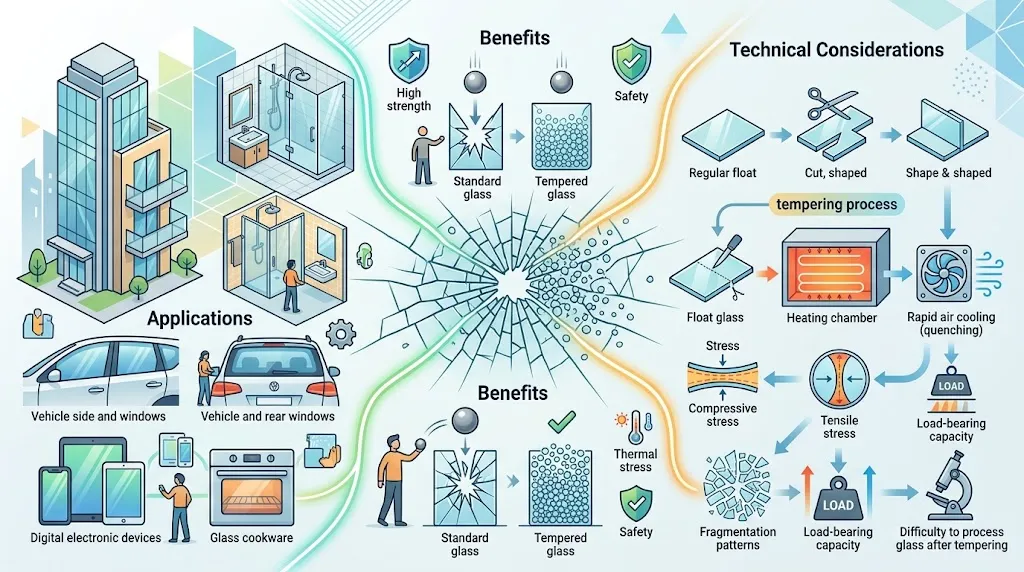
Tempered glass, also known as toughened glass, is one of the most widely used forms of safety glass in modern architecture. It combines increased mechanical strength, improved resistance to thermal stress, and a safer breakage pattern than ordinary annealed glass.
For architects, façade engineers, contractors, and glass procurement teams, however, selecting tempered glass is not simply a matter of choosing a thickness. The final specification must consider glass size, wind load, thermal stress, edge processing, holes and cutouts, supporting systems, coatings, lamination requirements, and applicable standards.
This guide explains how tempered glass works, where it is used, its principal benefits, and the technical factors that should be considered when specifying tempered glass for architectural projects.
What Is Tempered Glass?
Tempered glass is flat glass that has undergone a controlled heat-treatment process to increase its strength and safety characteristics.
During thermal tempering, the glass is heated and then rapidly cooled. This process creates compressive stress at the glass surfaces while balancing tensile stress develops within the interior. The resulting stress profile gives tempered glass significantly greater resistance to mechanical impact and thermal stress than annealed glass of comparable thickness.
Industry references commonly describe fully tempered glass as approximately four to five times stronger than annealed glass of the same thickness, depending on the property and test method being considered. Pilkington, for example, describes toughened glass as up to five times stronger than ordinary glass of the same thickness.
In the United States, ASTM C1048 covers heat-strengthened and fully tempered flat glass used in general building construction. The current ASTM C1048-25 specification also emphasizes that fabrication such as cutting, drilling, notching, grinding, and similar operations must be completed as specified before heat treatment. Tempered glass cannot simply be cut after tempering.
How Is Tempered Glass Manufactured?
The manufacturing process generally involves several important stages.
1. Glass Cutting
The starting material is normally annealed flat glass. It is cut according to the final project dimensions.
At this stage, manufacturers must consider the finished dimensions, tolerances, glass thickness, and the location of holes, notches, cutouts, and other details.
2. Edge Processing
Edges may be polished, ground, beveled, or otherwise processed according to the application.
This is particularly important for architectural glass because edge quality can affect handling, installation, and performance.
3. Drilling and Fabrication
Any required holes, slots, notches, or other fabrication should normally be completed before tempering.
This is a critical consideration for glass doors, point-fixed glazing, balustrades, canopies, shower enclosures, and other systems that require hardware connections.
ASTM C1048 specifically recognizes fabrication such as drilled holes, notches, cutouts, grinding, and edgework as operations associated with the glass before strengthening or tempering.
4. Heating
The prepared glass is heated in a controlled tempering furnace.
The objective is to bring the glass to the appropriate temperature and establish uniform heating across the pane.
5. Rapid Cooling
The heated glass is rapidly cooled, normally using forced air.
The different cooling rates between the surface and interior create the characteristic stress distribution of tempered glass.
6. Quality Inspection
Finished tempered glass can then be inspected for dimensions, visual quality, fragmentation characteristics, surface condition, and other project-specific requirements.
For international projects, the applicable standard may include ASTM, EN, GB, or another national or project-specific specification.
What Are the Main Benefits of Tempered Glass?
1. Higher Mechanical Strength
One of the primary reasons for using tempered glass is its increased resistance to mechanical loading compared with annealed glass.
This makes it particularly suitable for applications where glass may experience impact, wind pressure, handling loads, or other mechanical stresses.
Fully tempered glass is commonly described as approximately four times stronger than annealed glass under relevant strength comparisons, while some manufacturers describe it as up to five times stronger. The exact performance depends on the glass type, test method, thickness, and specification.
2. Improved Thermal Resistance
Tempered glass also has greater resistance to thermal stress than ordinary annealed glass.
This can be important in façades, doors, windows, curtain walls, skylights, and other locations where glass can experience temperature differences caused by sunlight, shading, building orientation, coatings, or adjacent materials.
However, tempered glass should not be considered completely immune to thermal breakage. Project-specific thermal analysis may still be required.
3. Safer Breakage Pattern
One of the most important safety characteristics of fully tempered glass is its breakage pattern.
When properly tempered glass breaks, it generally fractures into many smaller particles rather than the large sharp shards associated with ordinary annealed glass.
This characteristic helps reduce the potential severity of injuries in many architectural applications.
It is important to distinguish this from laminated safety glass. Tempered glass improves the breakage pattern, while laminated glass uses an interlayer to help hold broken glass together.
For higher-risk applications, architects may therefore specify tempered laminated glass, combining the mechanical and thermal benefits of tempering with the post-breakage retention characteristics of laminated construction.
Where Is Tempered Glass Used?
Tempered glass is used across residential, commercial, industrial, hospitality, transportation, and public-building projects.
Common applications include:
- Curtain walls
- Windows and façades
- Glass doors
- Frameless doors
- Shower enclosures
- Glass partitions
- Balustrades and railings
- Canopies
- Skylights
- Storefronts
- Interior architectural glazing
- Furniture and display glass
- Public transportation facilities
- Commercial and hospitality buildings
The appropriate configuration depends on the structural system, location, loads, human-impact risk, thermal environment, and applicable building regulations.
General architectural glass references identify applications such as doors, sidelites, curtain walls, handrails, partitions, storefronts, windows, and shower enclosures as common areas where tempered glass is used.
Tempered Glass for Curtain Walls and Building Façades
Curtain wall systems are one of the most demanding applications for architectural glass.
The glass may need to withstand:
- Wind pressure and suction
- Temperature changes
- Solar radiation
- Building movement
- Frame deflection
- Installation stresses
- Human impact requirements
- Long-term environmental exposure
For this reason, selecting glass only according to thickness is insufficient.
The complete glazing system should be evaluated, including the glass composition, panel dimensions, support conditions, frame system, sealants, gaskets, wind loads, and project-specific performance requirements.
ASTM C1048 specifically notes that the support system and the amount of glass deflection under wind-load conditions must be considered during design.
For high-performance façades, tempered glass may also be combined with Low-E coatings, insulating glass units, or laminated glass to achieve improved thermal, solar-control, acoustic, or safety performance.
Tempered Glass vs. Laminated Glass
Tempered glass and laminated glass are both important safety-glazing technologies, but they solve different problems.
| Characteristic | Tempered Glass | Laminated Glass |
|---|---|---|
| Mechanical strength | High | Depends on glass configuration |
| Breakage pattern | Small fragments | Glass generally remains attached to interlayer |
| Post-breakage retention | Limited | Strong advantage |
| Thermal resistance | Improved | Depends on glass/interlayer configuration |
| Security performance | Limited compared with laminated systems | Can be configured for enhanced security |
| Acoustic performance | Depends on configuration | Often advantageous with appropriate interlayers |
| Common applications | Doors, façades, partitions, shower enclosures | Curtain walls, skylights, overhead glazing, security glazing |
These two technologies are not necessarily alternatives.
For demanding architectural applications, tempered laminated glass can combine heat-treated glass with an interlayer system.
Tianhou Glass, for example, provides both tempered glass and laminated safety-glass solutions as part of its architectural glass processing capabilities. Its project portfolio includes curtain-wall and public-building applications using high-performance glass systems.
Important Technical Considerations When Specifying Tempered Glass
Glass Thickness
Thickness should be determined according to the application and engineering requirements rather than selected only according to visual preference.
Typical architectural projects may use different thicknesses depending on panel dimensions, wind loads, support conditions, impact requirements, and glass configuration.
For large façade panels, thicker glass or laminated/insulating configurations may be required.
Panel Dimensions
Large-format glass introduces additional engineering and manufacturing considerations.
The glass supplier should review:
- Overall dimensions
- Aspect ratio
- Thickness
- Weight
- Edge configuration
- Support conditions
- Transportation limitations
- Installation method
Large panels can also place greater demands on handling and installation equipment.
Holes and Cutouts
If glass requires holes for handles, fittings, spider connections, clamps, or other hardware, these locations must be defined before tempering.
Once glass has been tempered, conventional cutting and drilling operations cannot be performed in the same way as with annealed glass.
This is why accurate shop drawings and hardware coordination are essential before production.
Edge Quality
Edge processing should match the intended installation method.
For example, exposed edges on frameless doors, partitions, balustrades, and other architectural applications may require polished or otherwise specified edge treatment.
Coatings
Tempered glass can be combined with certain coated-glass systems.
For energy-efficient façades, Low-E coated glass can be incorporated into insulated or laminated configurations depending on the design requirements.
However, the compatibility of the coating, heat treatment, orientation, and fabrication process should be confirmed with the glass manufacturer.
Wind Load
Glass selection for façades cannot be separated from structural design.
The required glass configuration depends on:
- Design wind pressure
- Panel size
- Support conditions
- Glass thickness
- Glass composition
- Deflection limits
- Safety requirements
ASTM C1048 specifically identifies glass deflection and the supporting system as design considerations for heat-treated glass.
Why Fabrication Capability Matters
For project buyers, choosing a tempered glass supplier is not simply about purchasing a sheet of glass.
A reliable architectural glass supplier should be able to coordinate multiple processing stages, including:
- Glass cutting
- Edge processing
- Drilling
- Notching and cutouts
- Tempering
- Lamination when required
- Insulating-glass fabrication when required
- Quality inspection
- Packaging and transportation
- Project delivery coordination
This becomes particularly important for curtain-wall projects, hotels, transportation facilities, commercial buildings, and large residential developments where dozens or hundreds of different glass sizes may be required.
Tianhou Glass: Tempered Glass for Architectural Projects
Tianhou Glass is based in Zhuhai, Guangdong, within the Guangdong-Hong Kong-Macao Greater Bay Area, and focuses on architectural glass processing and project-oriented glass solutions.
According to Tianhou Glass’s project portfolio, its engineering work covers residential buildings, public buildings, industrial facilities, commercial landmarks, and other architectural applications. Its product capabilities include tempered glass, laminated glass, insulating glass, Low-E glass, fire-rated glass, and other processed architectural glass products.
For projects where tempered glass is only one component of a larger glazing system, Tianhou Glass can combine different processing technologies to develop a glass specification around the project’s actual requirements.
Example: Zhuhai Urban Rail Station Projects
Tianhou Glass has supplied architectural glass solutions for transportation infrastructure projects in Zhuhai.
Its project portfolio includes public-building and transportation-related applications involving high-performance glass for building envelopes and architectural structures.
For this type of project, glass selection needs to consider more than basic strength. Large public buildings and transportation facilities require coordinated consideration of safety, wind resistance, solar performance, visual quality, dimensions, processing accuracy, and installation requirements.
This illustrates why an experienced architectural glass processor can be more valuable than a supplier focused only on standard glass sheets.
Is Tempered Glass Always the Best Choice?
No.
Tempered glass is highly useful, but it is not automatically the correct solution for every application.
For example, applications requiring strong post-breakage glass retention may require laminated glass. Overhead glazing may require a carefully engineered laminated configuration. High-performance façades may require insulated Low-E glass. Security applications may require specialized laminated or bullet-resistant constructions.
The correct question is therefore not:
“Should we use tempered glass?”
but rather:
“What glass configuration provides the required safety, structural, thermal, solar, acoustic, and aesthetic performance for this specific application?”
This project-based approach helps architects and contractors avoid specifying glass based on thickness or product names alone.
Frequently Asked Questions About Tempered Glass
Is tempered glass stronger than ordinary glass?
Yes. Fully tempered glass generally has substantially greater mechanical strength than annealed glass of the same thickness. Industry references commonly describe the increase as approximately four to five times for relevant strength comparisons.
Can tempered glass be cut after manufacturing?
No. Conventional cutting, drilling, or similar fabrication cannot normally be performed after tempering. These operations need to be completed before heat treatment.
Does tempered glass break into sharp pieces?
When properly tempered and broken, it generally fractures into many smaller pieces rather than large sharp shards. This is one of the principal safety benefits of fully tempered glass.
Can tempered glass be laminated?
Yes. Tempered glass can be combined with an interlayer to produce tempered laminated glass. This can provide a combination of high-strength glass and improved post-breakage retention.
Is tempered glass suitable for curtain walls?
Yes, tempered glass is widely used in curtain-wall systems. However, the correct glass thickness and configuration must be determined according to panel dimensions, wind loads, support conditions, thermal requirements, safety requirements, and the applicable building standards.
Conclusion
Tempered glass has become a fundamental material in modern architectural glazing because it offers increased mechanical strength, improved resistance to thermal stress, and a safer breakage pattern than ordinary annealed glass.
But high-quality architectural glazing requires more than simply selecting “tempered glass.” Glass thickness, dimensions, edgework, holes, cutouts, coatings, laminated construction, insulating configurations, wind loads, support systems, and applicable standards all need to be considered before production.
For architects, façade contractors, developers, and international glass buyers, the best approach is to work with a glass manufacturer that can understand the complete project requirement and coordinate multiple processing technologies.
Tianhou Glass provides architectural glass processing and project-oriented solutions from its manufacturing base in Zhuhai, Guangdong, supporting applications ranging from building façades and curtain walls to public buildings, residential projects, transportation facilities, and specialized architectural glazing.