
News & Insights
Safety Glass Solutions for a Large Public Building
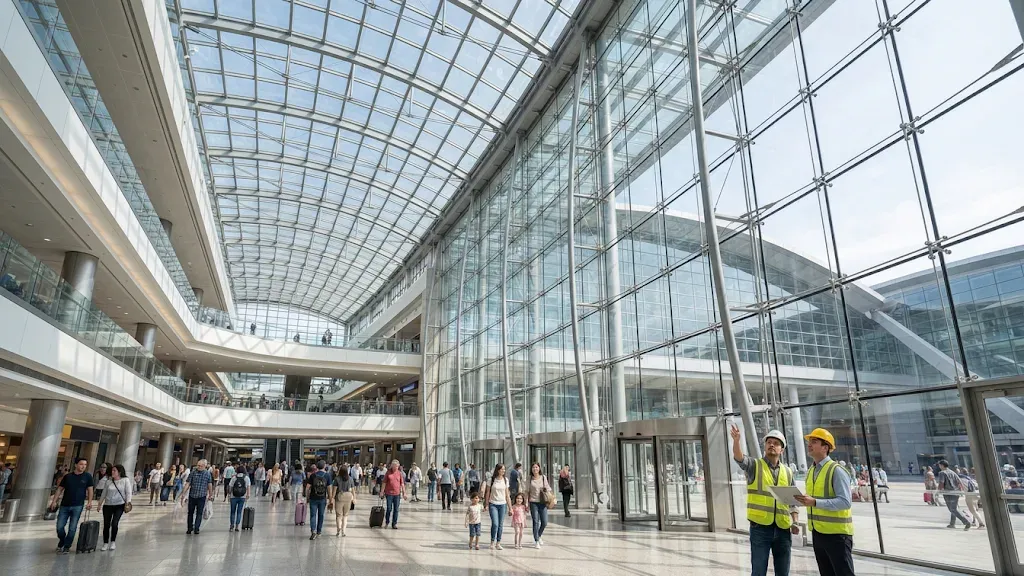
Large public buildings such as schools, hospitals, railway stations, shopping malls, and office complexes require more than attractive glass facades. Safety, durability, structural performance, and long-term reliability are essential when selecting architectural glass for high-traffic environments.
For architects, contractors, and developers, choosing the right safety glass solution helps reduce injury risks, improve building performance, and meet local building regulations.
1. Why Safety Glass Matters in Public Buildings
Public buildings experience constant pedestrian movement and frequent interaction with glass doors, partitions, windows, and curtain walls. Ordinary annealed glass can create dangerous sharp fragments when broken.
Safety glass is designed to reduce these risks through two main technologies:
- Tempered Glass: Heat-treated glass with greater mechanical and thermal resistance than ordinary annealed glass. When broken, it typically fragments into relatively small pieces, reducing the risk of severe cutting injuries.
- Laminated Glass: Two or more glass layers bonded with an interlayer, commonly PVB or SGP. When broken, the interlayer helps hold fragments together and maintain the integrity of the glazing.
For applications requiring additional protection, laminated tempered glass can combine the fragmentation characteristics of tempered glass with the fragment-retention benefits of laminated construction.
The appropriate solution depends on the building’s design, safety requirements, and applicable regulations.
2. Key Applications of Safety Glass
Different areas of a large public building require different glass specifications.
Glass Curtain Walls
Curtain walls are important architectural elements in commercial buildings, schools, and transportation facilities. Laminated or insulated laminated glass can provide improved post-breakage retention, while Low-E coatings can help control solar heat gain and improve energy efficiency.
Glass thickness, wind-load resistance, support systems, and installation conditions must be evaluated together.
Glass Doors and Entrance Systems
Entrances, automatic doors, and glass partitions are exposed to frequent human contact. Fully tempered or laminated safety glass is commonly selected according to the applicable safety glazing requirements.
Glass Railings and Balustrades
Glass railings in staircases, balconies, and elevated walkways require particular attention to impact resistance and post-breakage performance. Laminated safety glass is often preferred because its interlayer helps retain broken fragments.
Skylights and Canopies
Overhead glazing requires careful consideration of falling-glass risks, wind loads, maintenance access, and the consequences of glass breakage. Laminated glazing systems are commonly considered for these applications.
3. Understanding Safety Standards and Glass Specifications
Safety glass requirements vary by country and application.
For example:
- In the United States, relevant standards include ANSI Z97.1 and CPSC 16 CFR Part 1201.
- In Europe, EN 12600 provides a pendulum impact test and classification system for glass.
- ASTM C1172 covers laminated architectural flat glass, while ASTM C1048 covers heat-strengthened and fully tempered flat glass.
These standards address different aspects of glass performance and should not be treated as interchangeable certifications.
For large public building projects, buyers should confirm the required impact classification, glass configuration, thickness, interlayer material, and supporting system before production.
4. Tianhou Glass: Safety Glass for Public Infrastructure
With more than 15 years of experience in architectural and safety glass manufacturing, Guangdong Tianhou Glass Engineering Co., Ltd. provides glass processing solutions for commercial buildings, educational facilities, and public infrastructure projects.
Based in Zhuhai, Guangdong, Tianhou Glass operates a manufacturing facility of approximately 20,000 square meters, providing deep-processing capabilities for different architectural glass requirements.
Its project experience includes public facilities such as Zhuhai No. 26 Primary School, Beijing Normal University Zhuhai Affiliated School, Zhongshan North Railway Station, and other public infrastructure developments.
These projects demonstrate the importance of matching glass specifications with architectural requirements, project conditions, and installation environments.
Tianhou Glass offers a range of products, including:
- Fully tempered glass
- Laminated safety glass
- Tempered laminated glass
- Insulated glass
- Low-E glass
- Fire-rated glass
- Bullet-resistant glass
- Custom architectural glass
Each project can be evaluated according to its required dimensions, glass configuration, processing requirements, and applicable performance standards.
5. How to Choose the Right Safety Glass Supplier
Selecting a reliable glass manufacturer is an important part of public building procurement.
Before placing an order, project owners and contractors should consider:
- Manufacturing capability: Can the factory handle large glass dimensions, complex processing, and customized specifications?
- Quality control: Are production procedures, product inspections, and relevant test documentation available?
- Technical support: Can the supplier assist with glass configuration, thickness selection, and project-specific requirements?
- Project experience: Does the manufacturer have experience supplying glass for schools, commercial buildings, transportation facilities, or other public projects?
- Delivery reliability: Can the supplier coordinate production schedules, packaging, and transportation for large-scale orders?
A competitive price is important, but product performance, manufacturing consistency, and project coordination should also be considered.
Conclusion
Safety glass is a fundamental component of modern public building design. From curtain walls and entrance systems to glass railings and overhead glazing, every application requires an appropriate combination of safety performance, structural strength, and durability.
With architectural glass manufacturing experience, a comprehensive product range, and public infrastructure project experience, Tianhou Glass provides customized glass solutions for contractors, developers, and architectural projects worldwide.
Looking for a reliable safety glass manufacturer for your next public building project? Contact Tianhou Glass to discuss your glass specifications and project requirements.