
News & Insights
Large-Format Glass for a Modern Commercial Facade
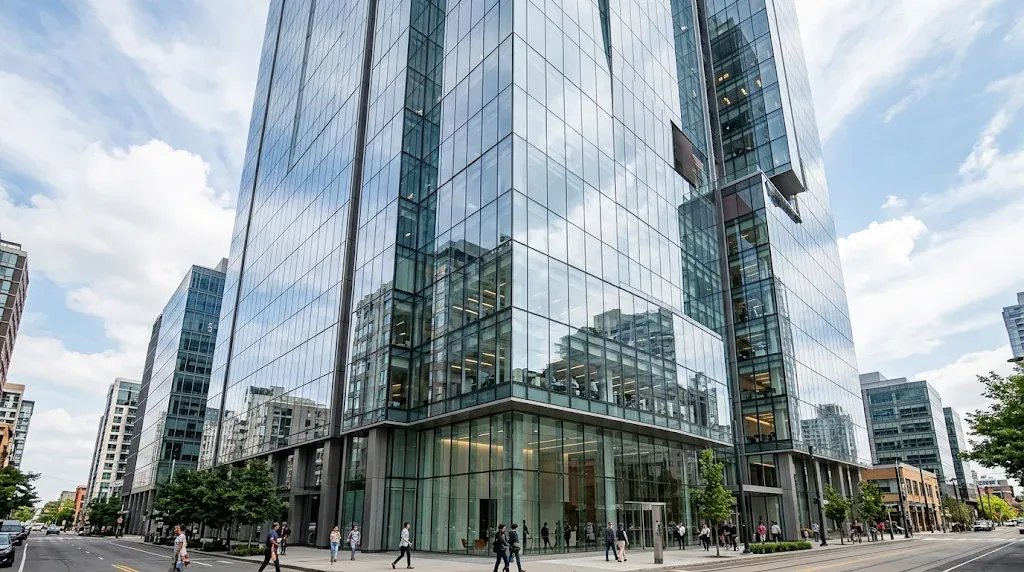
Modern commercial architecture increasingly uses large-format glass to create open, bright and visually striking building facades. From office towers and shopping centers to hotels and public buildings, oversized glass panels help architects achieve clean exterior lines, maximize natural daylight and establish a strong connection between indoor and outdoor spaces.
However, large-format glass is not simply conventional glass manufactured in a bigger size. Its production requires careful consideration of glass thickness, structural performance, wind loads, heat treatment, transportation and installation.
1. What Is Large-Format Glass?
Large-format glass generally refers to glass panels manufactured in dimensions larger than standard architectural glazing units. The exact definition depends on the manufacturer, glass type and project requirements.
It is commonly used in:
- Commercial building curtain walls
- Office building facades
- Shopping malls and retail buildings
- Hotels and luxury developments
- Airports and transportation hubs
- Large entrance systems and atriums
By reducing the number of visible joints and framing elements, large glass panels can create a more continuous and modern architectural appearance.
2. Key Technical Considerations
Selecting large-format glass requires more than determining the required panel dimensions.
Glass Thickness and Structural Safety
Glass thickness must be determined according to panel dimensions, support conditions, wind pressure, deflection requirements and applicable building codes. Larger panels may require thicker glass or laminated glass configurations to achieve the necessary structural performance.
Tempered and Laminated Glass
Heat-treated glass is widely used in commercial facades.
- Tempered glass offers increased resistance to mechanical and thermal stress compared with annealed glass of the same thickness.
- Laminated glass uses an interlayer, commonly PVB or SGP, to help retain glass fragments after breakage.
- Heat-strengthened glass may be considered where specific thermal and structural requirements apply.
The appropriate glass configuration depends on the building design, safety requirements and local regulations.
Thermal and Solar Performance
Large glazed facades can significantly influence a building’s energy performance. Insulating glass units (IGUs), Low-E coatings and solar-control glass can help reduce unwanted heat transfer and solar heat gain.
The overall performance depends on the complete glazing system, including glass composition, coatings, cavity, gas filling, spacer and frame design.
Manufacturing and Installation
Large panels require precise cutting, edge processing, hole positioning and quality inspection. Their weight and dimensions also affect packaging, transportation, lifting equipment and installation planning.
Early coordination between the glass manufacturer, facade contractor and structural engineer helps reduce fabrication and installation risks.
3. Why Architects Choose Large-Format Glass
Large-format architectural glass offers several advantages for modern commercial buildings.
- Modern aesthetics: Creates expansive glass surfaces with fewer visible joints.
- Natural daylight: Allows more daylight to enter interior spaces, depending on glass transparency and coating selection.
- Architectural flexibility: Supports contemporary curtain wall designs, oversized windows and customized facade systems.
- Energy performance: When combined with suitable Low-E coatings and insulating glass configurations, it can improve the thermal performance of building envelopes.
- Visual openness: Provides wider exterior views and a more spacious appearance.
4. Tianhou Glass: Architectural Glass Solutions for Commercial Projects
Based in Zhuhai, Guangdong, China, Guangdong Tianhou Glass Engineering Co., Ltd. specializes in architectural glass processing and customized glass solutions.
With a manufacturing facility of approximately 20,000 square meters and more than 15 years of industry experience, Tianhou Glass provides a range of products for commercial and architectural applications, including:
- Large-format tempered glass
- Laminated safety glass
- Insulating glass units
- Double silver and other Low-E glass
- Ultra-clear glass
- Customized curtain wall glass
- Special-shaped architectural glass
Tianhou Glass has supplied architectural glass solutions for projects including Fushan Smart Manufacturing Town, Zhuhai No. 26 Primary School and other commercial, educational and public buildings.
These projects demonstrate the importance of coordinating glass processing, product specifications and project delivery requirements for different architectural applications.
For large-format facade projects, Tianhou Glass can work with customers to evaluate panel dimensions, glass composition, processing requirements and packaging arrangements according to project drawings and technical specifications.
5. How to Choose the Right Large-Format Glass Supplier
When selecting a large-format glass manufacturer, commercial developers and facade contractors should consider several factors:
- Manufacturing capability: Confirm that the factory can process the required glass dimensions, thicknesses and configurations.
- Quality control: Check cutting accuracy, edge quality, tempering consistency and inspection procedures.
- Technical coordination: Ensure that the supplier can review drawings and coordinate glass specifications with the facade engineering team.
- Packaging and logistics: Large glass panels require appropriate protective packaging and transportation planning.
- Project experience: Evaluate the supplier’s experience with commercial buildings, curtain walls and customized architectural glass.
It is also important to ensure that the final glass specification complies with applicable building codes and project-specific engineering requirements. ASTM E1300-24 provides a recognized method for evaluating the load resistance of glass used in buildings.
Conclusion
Large-format glass is an important material for modern commercial facades, combining architectural aesthetics, daylighting and functional performance.
Successful applications depend on the right balance between glass dimensions, structural safety, thermal performance, manufacturing capabilities and installation conditions.
With its architectural glass processing experience, customized product range and manufacturing base in Zhuhai, Tianhou Glass supports commercial building developers, facade contractors and international glass buyers seeking reliable architectural glass solutions.
Looking for a large-format glass manufacturer in China? Contact Tianhou Glass to discuss your commercial facade project and customized glass requirements.