
News & Insights
How Glass Thickness Affects Strength, Safety and Performance
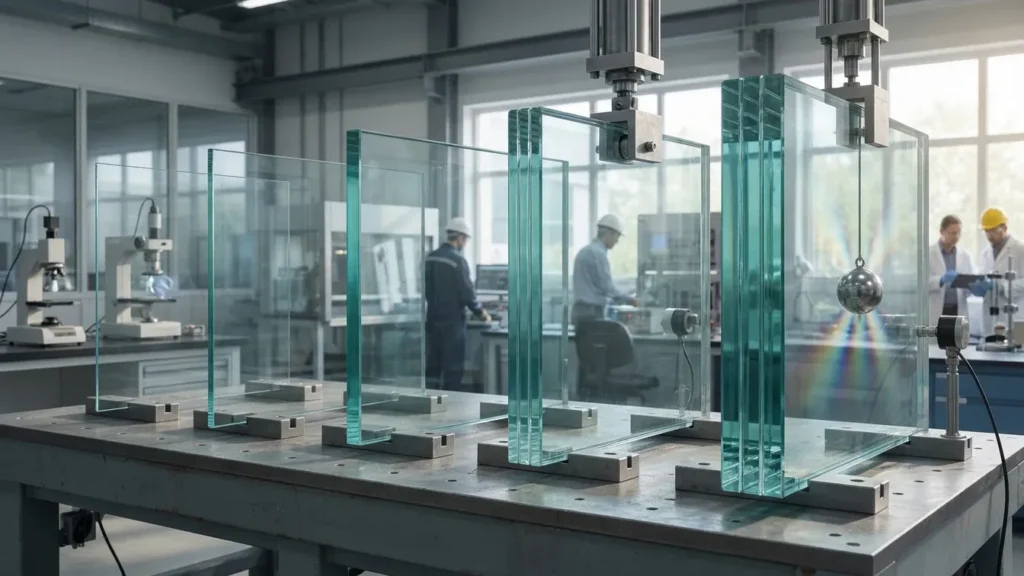
Glass thickness is one of the most important factors in architectural glass selection. It influences load-bearing capacity, bending stiffness, deflection, weight and overall building performance. However, thicker glass does not automatically mean safer or better glass. The correct specification depends on glass type, panel dimensions, installation conditions and project requirements.
For architects, contractors and developers, understanding how glass thickness affects performance helps avoid unnecessary costs while maintaining structural reliability and safety.
1. How Glass Thickness Affects Strength
Glass thickness directly influences its ability to resist external loads, including wind pressure, impact and other mechanical forces.
A thicker glass panel generally provides:
- Greater bending stiffness.
- Better resistance to excessive deflection.
- Higher load-bearing potential under comparable conditions.
- Greater structural flexibility in large-panel applications.
One important engineering principle is that the bending stiffness of a glass plate is proportional to the cube of its thickness, assuming the same material properties.
For example, increasing glass thickness from 6 mm to 12 mm theoretically increases its bending stiffness by approximately eight times under comparable conditions.
However, actual load resistance also depends on panel dimensions, support conditions, glass quality and load duration.
2. Glass Thickness and Safety Performance
Glass safety is determined by more than thickness. Heat treatment and laminated construction are equally important.
Three common glass types serve different purposes:
Annealed Glass
Standard annealed glass is commonly used in applications where safety glazing is not specifically required. When broken, it forms relatively large, sharp fragments.
Heat-Strengthened Glass
Heat-strengthened glass generally has approximately twice the breakage strength of annealed glass of the same thickness and configuration. It is suitable for applications requiring additional resistance to thermal and mechanical stresses.
Fully Tempered Glass
Fully tempered glass generally has approximately four times the breakage strength of comparable annealed glass. When broken, it fractures into relatively small fragments, reducing the risk of serious cutting injuries.
Laminated glass combines two or more glass layers with an interlayer, commonly PVB or SGP. If the glass breaks, the interlayer helps retain the fragments and maintain the integrity of the glazing assembly.
For applications such as glass railings, curtain walls, skylights and public buildings, selecting the appropriate safety glass construction is essential.
3. How Thickness Affects Thermal and Acoustic Performance
Glass thickness also influences building energy efficiency and acoustic performance, but it is not the only determining factor.
Thermal Performance
In insulated glass units (IGUs), overall thermal performance depends on several factors:
- Glass thickness and configuration.
- Air or argon gas cavity width.
- Low-E coating specifications.
- Spacer and edge-seal design.
Simply increasing the thickness of a single glass pane does not provide the same thermal improvement as selecting a properly designed insulated glass unit.
Acoustic Performance
Glass thickness and laminated construction can influence sound insulation. Different glass thicknesses can also help reduce certain sound transmission frequencies.
For projects near highways, airports or commercial areas, laminated acoustic glass or specially designed insulated glass units may provide better results than simply choosing thicker monolithic glass.
4. Common Glass Thicknesses for Architectural Applications
Different architectural applications require different glass specifications.
| Glass Thickness | Typical Applications |
|---|---|
| 4–5 mm | Small windows and lightweight glazing |
| 6 mm | Residential windows and general glazing |
| 8 mm | Interior partitions and medium-sized panels |
| 10 mm | Glass doors, partitions and certain facade applications |
| 12 mm | Curtain walls, doors and larger glazing panels |
| 15–19 mm | Specialized structural and heavy-duty glazing |
These are general application examples, not universal design recommendations. Actual thickness must be verified through engineering calculations and applicable building regulations.
5. How Tianhou Glass Helps Select the Right Glass Thickness
At Guangdong Tianhou Glass Engineering Co., Ltd., glass specification is approached from both manufacturing and project application perspectives.
Based in Zhuhai, Guangdong, Tianhou Glass provides architectural and safety glass solutions for construction and commercial projects.
With glass deep-processing capabilities, Tianhou Glass supports different product requirements, including:
- Tempered Glass
- Laminated Glass
- Insulated Glass
- Low-E Glass
- Fire-Rated Glass
- Bulletproof Glass
- Custom Architectural Glass
For example, when evaluating glass for a curtain wall project, Tianhou Glass considers panel dimensions, wind-load requirements, glass configuration, safety requirements and installation conditions before recommending a suitable processing solution.
For a public building requiring additional impact protection, laminated or tempered laminated glass may be more appropriate than simply increasing the thickness of a single glass pane.
The objective is to balance structural performance, safety, manufacturing feasibility and project cost.
6. How to Choose the Correct Glass Thickness
Before placing a glass order, project owners and contractors should consider several key questions:
- What are the dimensions and aspect ratio of each glass panel?
- What wind pressure and other design loads must the glass withstand?
- Does the application require tempered or laminated safety glass?
- What are the support and installation conditions?
- Are thermal insulation or acoustic performance important?
- Which local building codes and safety standards apply?
For complex applications, glass thickness should be determined through professional engineering calculations rather than general recommendations.
Conclusion
Glass thickness plays an important role in structural strength, safety and building performance. However, the best solution is not necessarily the thickest glass. Glass type, heat treatment, laminated construction, coatings and installation conditions must all be considered together.
Tianhou Glass provides customized architectural and safety glass processing solutions to help contractors, architects and developers select suitable glass configurations for different project requirements.
Looking for the right glass specification for your next project? Contact Tianhou Glass to discuss your glass thickness, processing and architectural glazing requirements.