
News & Insights
How Green Building Standards Are Reshaping Glass Specifications
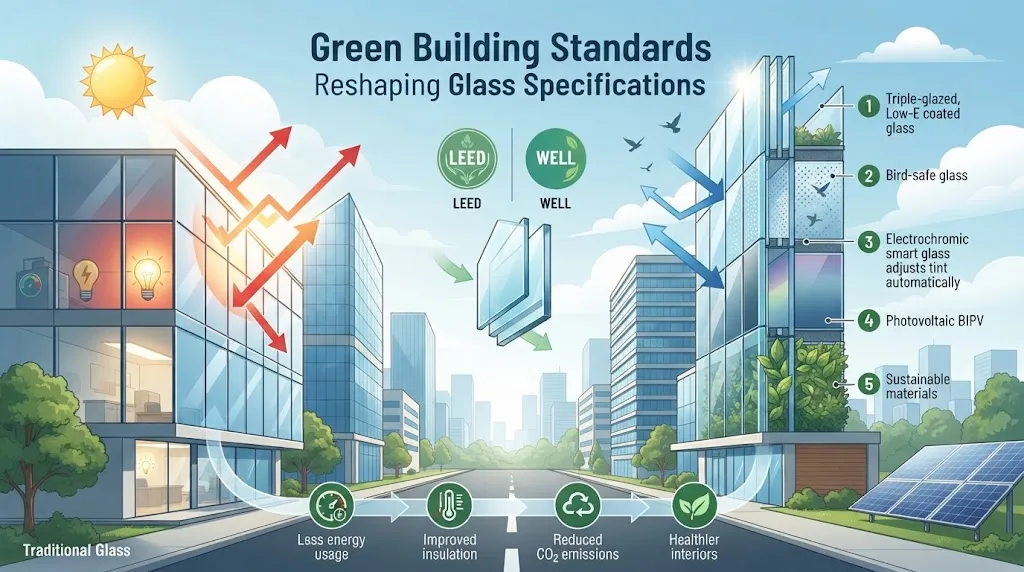
Green building standards are changing the way architects, developers and contractors select architectural glass. Glass is no longer specified only for transparency, appearance and structural safety. Its thermal performance, solar control, natural daylight, durability and environmental impact are becoming increasingly important.
As sustainability requirements become stricter worldwide, architectural glass manufacturers and suppliers must adapt to new project expectations.
1. Energy Efficiency Is Becoming a Core Glass Requirement
One of the biggest priorities in green building design is reducing energy consumption from heating, cooling and artificial lighting.
Windows and glass curtain walls can significantly influence a building’s thermal performance. Poorly selected glazing may increase solar heat gain in summer and heat loss in winter.
To address these challenges, architects increasingly specify:
- Low-E Glass: Special coatings help control heat transfer while maintaining natural daylight.
- Insulated Glass Units (IGUs): Double or triple glazing reduces heat transfer through the glass assembly.
- Solar Control Glass: Helps reduce unwanted solar heat gain, particularly in buildings exposed to strong sunlight.
- Vacuum Insulated Glass: Uses a vacuum space between glass panes to achieve high thermal insulation in a relatively thin glazing unit.
Glass specifications should consider three important performance indicators:
- U-Factor: Measures heat transfer. A lower value generally indicates better insulation.
- Solar Heat Gain Coefficient (SHGC): Measures how much solar heat enters through the glazing. Lower values mean less solar heat gain.
- Visible Light Transmittance (VLT): Measures how much visible light passes through the glass.
The ideal combination depends on the building’s location, orientation, climate and energy design.
2. Green Building Certifications Are Influencing Material Selection
International green building frameworks are making environmental performance an important part of construction procurement.
Several major standards influence architectural glass specifications:
LEED (Leadership in Energy and Environmental Design)
Developed by the U.S. Green Building Council, LEED evaluates building sustainability through areas including energy performance, materials, indoor environmental quality and carbon reduction.
The latest LEED v5 framework places stronger emphasis on decarbonization, including operational and embodied carbon.
BREEAM
The Building Research Establishment Environmental Assessment Method evaluates building performance across categories such as energy, materials, health and wellbeing, and environmental impact.
EU Energy Performance of Buildings Directive (EPBD)
The revised 2024 directive introduces progressively stricter requirements for building energy performance. From 2030, all new buildings in the EU are required to meet the zero-emission building standard, subject to the directive’s provisions.
It also introduces life-cycle global warming potential calculations, including embodied and operational emissions.
For glass suppliers, these developments mean that product selection increasingly requires documented performance data rather than relying on general descriptions such as energy-saving or environmentally friendly.
3. Embodied Carbon and Product Documentation Matter More
Energy efficiency during building operation is only one part of sustainable construction.
Developers are increasingly considering the environmental impact of materials throughout their life cycle, including:
- Raw material extraction and processing.
- Manufacturing energy consumption.
- Transportation to construction sites.
- Product service life and maintenance.
- End-of-life recycling and disposal.
Environmental Product Declarations (EPDs), where available, help project teams assess the environmental impacts of construction products using standardized life-cycle assessment methods.
For architectural glass manufacturers, this creates several important priorities:
- Improve manufacturing efficiency and reduce production waste.
- Optimize glass processing and material utilization.
- Provide reliable technical specifications and environmental documentation.
- Consider durability, maintenance and potential recycling.
Glass suppliers should also distinguish between verified environmental data and general sustainability claims. An energy-efficient glass product does not automatically have a low embodied carbon footprint.
4. Daylight, Comfort and Solar Control Must Work Together
Modern green buildings aim to balance energy efficiency with occupant comfort.
Large glass facades provide natural daylight and outdoor views, but excessive solar radiation can increase cooling demand and cause glare.
This is particularly important for commercial buildings, hotels, educational facilities and large public buildings.
The appropriate glass specification should balance:
- Natural daylight availability.
- Solar heat control.
- Thermal insulation.
- Glare management.
- Visual transparency.
- Indoor comfort.
For example, a commercial building in a hot climate may benefit from solar-control Low-E insulated glass with an appropriately selected SHGC.
In colder climates, the design may prioritize lower heat transfer while maintaining suitable solar heat gain.
There is no universal glass configuration for every green building. Performance should be evaluated as part of the complete building envelope, including frames, spacers, seals and installation details.
5. How Tianhou Glass Supports Sustainable Building Projects
Tianhou Glass is a professional architectural and safety glass manufacturer based in Zhuhai, Guangdong, China. Established in 2011, the company operates a manufacturing facility of approximately 20,000 square meters, providing glass processing solutions for commercial, residential and public construction projects.
As green building requirements become more important, Tianhou Glass provides different glass solutions to meet project-specific performance requirements.
Its product capabilities include:
- Low-E Glass: Suitable for energy-conscious windows and curtain wall applications.
- Insulated Glass: Helps improve thermal and acoustic performance in building envelopes.
- Vacuum Insulated Glass: An option for projects requiring high thermal insulation with limited glazing thickness.
- Laminated Glass: Provides safety performance and additional acoustic benefits depending on the configuration.
- Tempered Glass: Offers enhanced mechanical strength and safety characteristics.
- Curtain Wall Glass: Customized glazing solutions for commercial buildings and architectural facades.
For example, in commercial and educational building projects such as Zhuhai No. 26 Primary School and Beijing Normal University Zhuhai Affiliated School, glass selection needs to consider safety, natural lighting, durability and the functional requirements of the building.
These considerations also form an important part of sustainable architectural design.
For international projects, Tianhou Glass can work with architects, contractors and procurement teams to evaluate glass thickness, coating options, insulated configurations, processing requirements and project-specific technical specifications.
6. What Should Buyers Include in a Green Building Glass Specification?
When sourcing architectural glass for a sustainable construction project, buyers should provide more than dimensions and glass thickness.
A comprehensive specification should include:
| Specification | Information Required |
|---|---|
| Thermal performance | U-value or Ug-value, as applicable |
| Solar performance | SHGC and solar transmittance |
| Daylight performance | Visible light transmittance |
| Glass configuration | Single, double, triple or vacuum insulated |
| Safety requirements | Tempered, laminated or fire-rated glass |
| Environmental documentation | EPD and other available product data |
| Quality requirements | Applicable testing and certification |
| Project conditions | Climate, building orientation and application |
It is also important to clarify whether performance values refer to the glass center, the complete glazing unit or the entire window system. These measurements are not interchangeable.
Working with an experienced glass manufacturer early in the design stage can help avoid specification conflicts, unnecessary costs and performance problems during installation.
Conclusion: Sustainable Buildings Need Better Glass Specifications
Green building standards are transforming architectural glass from a basic construction material into an important component of building energy performance and environmental responsibility.
Low-E coatings, insulated glass, vacuum insulated glass and solar-control solutions are becoming increasingly relevant to modern construction.
At the same time, embodied carbon, product transparency and environmental documentation are creating new expectations for glass manufacturers.
For architects, developers and contractors, choosing the right glass supplier is therefore an important part of delivering sustainable buildings.
Tianhou Glass, with its architectural glass processing capabilities and experience in construction projects, aims to provide customized glass solutions for global building projects.
Contact Tianhou Glass to discuss your next architectural glass project and obtain a glass specification tailored to your building’s performance requirements.