
News & Insights
How Is Architectural Glass Manufactured for Large Building Projects?
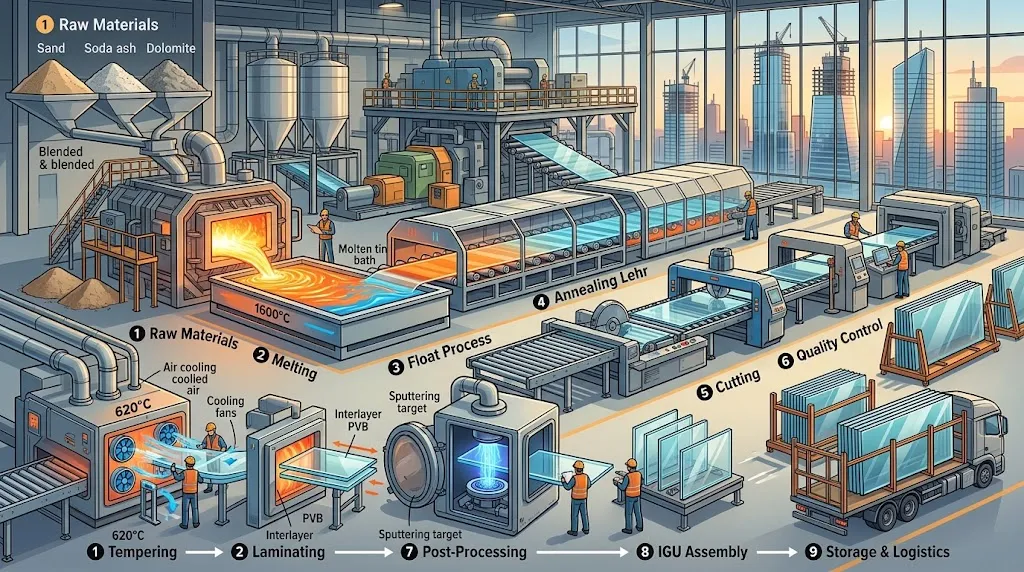
Architectural glass is not simply cut from a large sheet and installed on a building. For modern commercial towers, residential developments, industrial buildings, transportation hubs and curtain wall systems, glass typically passes through a sequence of material selection, cutting, edge processing, heat treatment, coating, laminating, insulating-unit assembly, inspection and packaging.
The exact manufacturing route depends on the building’s structural design, thermal requirements, safety requirements, façade system, dimensions and local building codes.
For large projects, the manufacturing challenge is therefore not only making glass, but producing thousands of individual glass units with consistent dimensions, optical quality, safety performance and traceability.
At Guangdong Tianhou Glass Engineering Co., Ltd., this type of project-oriented processing is part of the company’s architectural glass and curtain wall business.
What Is Architectural Glass?
Architectural glass refers to glass products designed and processed for use in buildings and related architectural applications.
It can include:
- Float glass
- Low-iron glass
- Tinted glass
- Tempered glass
- Heat-strengthened glass
- Laminated glass
- Insulating glass units (IGUs)
- Low-E glass
- Solar-control glass
- Decorative glass
- Safety and security glass
- Glass used in curtain walls, windows, doors, skylights and façades
ASTM C1036-25 covers quality requirements for flat glass used primarily in architectural glazing products, including coated glass, insulating glass units, laminated glass and related applications.
This is important because a building project normally does not specify simply “glass.” Instead, the project specification defines a glass make-up based on performance requirements.
For example:
10 mm Low-E tempered glass + 16 mm argon cavity + 10 mm tempered glass
is fundamentally different from:
8 mm + 1.52 mm PVB + 8 mm laminated glass.
Each configuration is manufactured differently and serves a different architectural purpose.
The Architectural Glass Manufacturing Process
For a large building project, the manufacturing process can generally be understood as:
Raw glass → Cutting → Edge processing → Drilling/fabrication → Heat treatment → Coating or surface treatment → Laminating / IGU assembly → Inspection → Packaging → Delivery
Not every product goes through every step.
For example, monolithic tempered glass may stop after heat treatment, while a high-performance curtain wall unit may require Low-E coating, tempering, spacer assembly, gas filling and sealing.
1. Float Glass Provides the Starting Material
Most architectural glass processing begins with flat float glass.
The float process was invented by Sir Alastair Pilkington in 1952 and remains the basic industrial method used to manufacture high-quality flat glass.
In the process, raw materials are melted in a furnace and the molten glass flows onto a bath of molten tin. Because the glass floats on the tin surface, it forms a highly flat continuous ribbon.
Pilkington states that modern float production can manufacture glass from approximately 0.4 mm to 25 mm thick, depending on the product and manufacturing line.
A typical float-glass sequence includes:
- Batch preparation
- Melting and refining
- Float-bath forming
- Annealing
- Automated inspection
- Cutting
During production, the glass ribbon is carefully cooled to reduce internal stresses before it is cut into sheets.
The manufacturing line itself can be extremely large. Pilkington describes float lines that can be nearly half a kilometre long, with production reaching thousands of tonnes per week.
This explains an important point for building projects:
Architectural glass fabricators generally do not start by melting sand for every project.
Instead, a fabricator purchases or sources suitable float glass from primary glass manufacturers and then performs the downstream processing required by the architectural specification.
2. Glass Is Cut According to the Project Schedule
After the appropriate base glass has been selected, large sheets are cut into the required dimensions.
For a large building, this is a much more complicated operation than cutting identical rectangles.
A façade may contain:
- Different widths
- Different heights
- Different glass thicknesses
- Openings for fittings
- Notches
- Different edge conditions
- Different coating orientations
- Different glass compositions
The fabrication drawings therefore become an important part of manufacturing.
For large projects, digital cutting systems can optimize the cutting pattern to reduce waste while maintaining the required dimensions and production sequence.
Pilkington describes computer-controlled cutting patterns designed to minimize material waste and connect production with customer orders.
3. Edge Processing, Holes and Other Fabrication
Before glass is tempered, laminated or assembled into an insulating glass unit, additional fabrication may be required.
Depending on the project, this can include:
- Edge grinding
- Polishing
- Drilling
- Notching
- Cut-outs
- Holes for fittings
- Special shapes
- Surface treatment
This stage is especially important for façade systems, doors, balustrades and other applications where glass interfaces directly with hardware.
One critical manufacturing principle is that heat-treated glass cannot simply be cut after tempering.
ASTM C1048-25 specifically requires fabrication such as cutting, edgework, drilling, notching and grinding to be completed before heat strengthening or tempering.
Therefore, the fabrication sequence must be carefully planned before a glass sheet enters the tempering furnace.
4. Tempering Makes Glass Suitable for Demanding Applications
Tempered glass is produced through controlled thermal treatment.
The glass is heated and then rapidly cooled using controlled air flow. This creates a different stress profile through the glass, increasing its mechanical strength compared with annealed glass.
Tempering is widely used for:
- Curtain walls
- Doors and windows
- Commercial buildings
- Skylights
- Balustrades
- Interior partitions
- Transportation facilities
ASTM C1048-25 defines requirements for heat-strengthened and fully tempered flat glass used in general building construction. It also distinguishes heat-strengthened glass from fully tempered glass.
The key point for project procurement is that tempering is performed after all required cutting and fabrication.
A mistake in hole position, edge dimensions or overall size discovered after tempering may mean that the glass cannot simply be re-cut.
That is why dimensional verification before tempering is an important quality-control step.
5. Low-E Coatings Add Thermal Performance
Modern building façades often need more than transparency.
Glass can also help control:
- Solar heat gain
- Thermal transfer
- Daylight
- Glare
- Interior comfort
- Building energy performance
Low-E, or low-emissivity, coatings are commonly used to modify the thermal and solar characteristics of architectural glass.
Depending on the coating technology, coatings may be applied during or after the primary glass manufacturing process.
Pilkington describes online chemical vapor deposition (CVD) as a method for applying extremely thin coatings to glass during float production.
In a building project, the Low-E glass may subsequently be processed into a larger glazing configuration such as an insulating glass unit.
This is why a specification such as:
double-silver Low-E + tempered glass + insulating cavity
represents a complete performance strategy rather than simply a particular glass color.
6. Laminated Glass Combines Glass and an Interlayer
Laminated glass is manufactured by bonding two or more glass lites with a polymer interlayer.
The interlayer can help keep broken glass together and can also contribute to acoustic, security, UV-control and other performance characteristics depending on the complete glass make-up.
Guardian Glass describes laminated glass as two or more glass lites permanently bonded with one or more polymer interlayers using heat and pressure.
Typical laminated architectural glass may therefore consist of:
Glass + interlayer + glass
or, for more demanding configurations:
Tempered glass + interlayer + tempered glass
The final composition depends on the project’s structural, safety, acoustic, security and façade requirements.
ASTM C1172-24 covers laminated architectural flat glass and includes applications such as safety, security, hurricane/cyclic-wind resistance, blast resistance, bullet resistance, sound reduction and decorative glazing.
7. Insulating Glass Units Are Assembled as Complete Systems
Insulating glass units, commonly called IGUs, are manufactured by combining two or more glass panes with a sealed cavity between them.
A typical double-glazed unit contains:
Glass + spacer + sealed cavity + glass
The cavity may contain air or another insulating gas, depending on the specification.
Modern IGUs may incorporate:
- Clear glass
- Low-E glass
- Solar-control glass
- Tempered glass
- Laminated glass
- Warm-edge spacers
- Gas-filled cavities
The exact configuration is determined by thermal, solar, acoustic, structural and aesthetic requirements.
Guardian Glass describes IGU production as combining float glass, Low-E coatings, safety glass and spacer systems into complete insulating units.
For large curtain wall projects, IGU manufacturing therefore becomes a system-level process rather than simply assembling two pieces of glass.
8. Quality Control Becomes More Important as Project Size Increases
A large building may require thousands of individual glass units.
The manufacturing challenge is therefore consistency.
A single glass panel may look acceptable, but a façade containing thousands of panels can reveal small inconsistencies in:
- Color
- Reflection
- Dimensions
- Flatness
- Edge quality
- Coating appearance
- Hole position
- Glass composition
- Insulating-unit sealing
- Optical distortion
Primary glass manufacturers use automated inspection systems to identify defects during float production. Pilkington reports automated inspection capable of making more than 100 million measurements per second across the ribbon in its described process.
For downstream architectural fabrication, quality control should continue through:
Incoming glass inspection → dimensional inspection → fabrication inspection → tempering inspection → lamination/IGU inspection → final inspection → packaging inspection
This is particularly important for large façade projects because replacement glass can affect both cost and construction schedule.
9. Manufacturing Sequence Must Match the Building Schedule
Large projects create another challenge that is easy to overlook:
Glass must not only be manufactured correctly; it must be manufactured in the correct sequence.
A high-rise façade may contain hundreds or thousands of unique panels.
If glass is delivered randomly, installation teams may have difficulty locating the correct panel.
Therefore, project-oriented glass fabrication can involve:
- Panel numbering
- Drawing-based production
- Batch production
- Floor-by-floor sequencing
- Zone-based packaging
- Installation-order packaging
- Delivery scheduling
For international projects, packaging also becomes important because oversized glass must survive transportation, handling and site installation without damage.
How Tianhou Glass Approaches Large Architectural Glass Projects
For a glass manufacturer, the value of a large project is not simply the ability to process one large piece of glass.
The real requirement is the ability to turn a building specification into a repeatable manufacturing process.
Tianhou Glass’s published project portfolio includes architectural glazing projects in Zhuhai and Zhongshan covering tempered glass, laminated glass, Low-E glass, insulating glass and high-performance curtain wall systems.
Fushan Industrial Park Smart Manufacturing Town
One example is the Fushan Industrial Park Smart Manufacturing Town project in Zhuhai.
Tianhou Glass’s published project information identifies the application as a public-building / industrial-park project using a high-performance Low-E double-silver insulating laminated curtain wall system.
This type of project demonstrates why architectural glass manufacturing is a multi-stage process.
A façade glass unit may need to combine:
- High-performance Low-E glass
- Heat-treated glass
- Laminated construction
- Insulating performance
- Curtain wall compatibility
- Dimensional consistency
The manufacturing objective is therefore not simply producing transparent panels. It is producing a specified glazing system that can be integrated into the building envelope.
Zhongjing 5G Industrial Building
Tianhou Glass also lists the Zhongjing 5G Industrial Building in Zhuhai as an architectural glass project using insulating glass for its building façade.
This illustrates another common requirement for commercial and industrial buildings: combining large-area glazing with thermal and façade-performance requirements.
Zhuguang New City
Tianhou Glass’s published portfolio also lists Zhuguang New City in Zhuhai, with high-performance Low-E glass identified as the core glass application.
Together, these projects show how the same architectural glass manufacturer may need to process different combinations of tempered, laminated, Low-E and insulating glass depending on the building design.
What Makes Large-Building Glass Manufacturing Difficult?
The most difficult part is usually not one individual manufacturing step.
It is coordinating the entire production chain.
For a large project, the manufacturer has to control at least five dimensions:
1. Dimensional accuracy
Glass must match the architectural and façade drawings.
2. Performance
The final glass composition must meet the required thermal, solar, safety, acoustic or security performance.
3. Optical consistency
Large façades make visual differences much easier to notice.
4. Production consistency
Thousands of panels need to maintain consistent quality.
5. Logistics
Finished glass must arrive at the construction site in the correct sequence and without damage.
This is why choosing a glass supplier for a large building project should involve more than comparing the price per square meter.
What Should Buyers Ask an Architectural Glass Manufacturer?
Before placing a large project order, architects, façade contractors and procurement teams should clarify:
1. What glass composition is required?
Clear, low-iron, tinted, Low-E, solar-control, tempered, laminated or insulating?
2. What are the maximum glass dimensions?
Large-format glass requires appropriate processing and transportation capabilities.
3. Which standards apply?
The project may specify ASTM, EN, BS, JIS, GB or other regional standards.
4. How are glass dimensions controlled?
Ask how dimensional inspection is performed before and after processing.
5. How is Low-E coating orientation controlled?
Incorrect coating position can affect the intended performance of an IGU.
6. How are laminated glass units inspected?
Interlayer quality, bonding and appearance should be controlled.
7. How are IGUs sealed and inspected?
Sealing quality is important for long-term insulating-glass performance.
8. Can production be synchronized with installation?
This is especially important for high-rise and large curtain wall projects.
9. How is each panel identified?
Panel identification and traceability reduce installation errors.
10. How will the glass be packaged and transported?
Large glass can be damaged by poor handling even when manufacturing quality is good.
Frequently Asked Questions
How is architectural glass manufactured?
Architectural glass typically starts with float glass and then undergoes project-specific processing such as cutting, edgework, drilling, tempering, coating, laminating or insulating-glass assembly. The final process depends on the building’s performance and design requirements.
What is the difference between tempered and laminated architectural glass?
Tempered glass is heat-treated to improve its mechanical and thermal performance, while laminated glass consists of two or more glass lites bonded with an interlayer. Laminated glass can provide safety, security, acoustic and other performance benefits depending on its configuration.
Why is Low-E glass used in large buildings?
Low-E coatings can modify the thermal and solar characteristics of glazing. They are commonly incorporated into high-performance architectural glazing systems, particularly insulating glass units.
What is an insulating glass unit?
An insulating glass unit is a sealed glazing assembly made from two or more panes separated by a spacer and cavity. The glass can incorporate Low-E coatings, tempered glass or laminated glass depending on the project specification.
Can tempered glass be cut after tempering?
No. Required cutting, drilling, notching and other fabrication should generally be completed before tempering. ASTM C1048 specifically states that heat-treated glass cannot be cut after tempering.
What standards are relevant to architectural glass?
The applicable standard depends on the product and project location. For example, ASTM C1036-25 addresses flat glass, ASTM C1048-25 covers heat-strengthened and fully tempered flat glass, and ASTM C1172-24 covers laminated architectural flat glass.
Conclusion: Architectural Glass Is a Manufacturing System, Not Just a Material
The production of architectural glass for a large building project is a controlled chain that starts with high-quality float glass and can continue through precision cutting, fabrication, tempering, Low-E coating, lamination, insulating-glass assembly, inspection, packaging and project-specific delivery.
For architects and façade contractors, the important question is therefore not simply:
“How much does the glass cost per square meter?”
A better question is:
“Can the manufacturer consistently produce the specified glass configuration, in the required dimensions and sequence, while maintaining quality throughout the project?”
That is the difference between supplying glass and manufacturing glass for a major building project.
With experience in architectural glazing, curtain wall glass and specialized glass processing, Tianhou Glass focuses on project-oriented glass solutions for commercial buildings, residential developments, industrial facilities and other architectural applications.