
News & Insights
Tempered Glass vs. Laminated Glass: Which Is Better for Safety?
When choosing glass for a commercial building, hotel, school, office, or residential project, safety should be one of the first considerations. Two of the most widely used options are tempered glass and laminated glass. Both can provide safety benefits, but they behave differently when subjected to impact or breakage.
So, which is better: tempered glass or laminated glass?
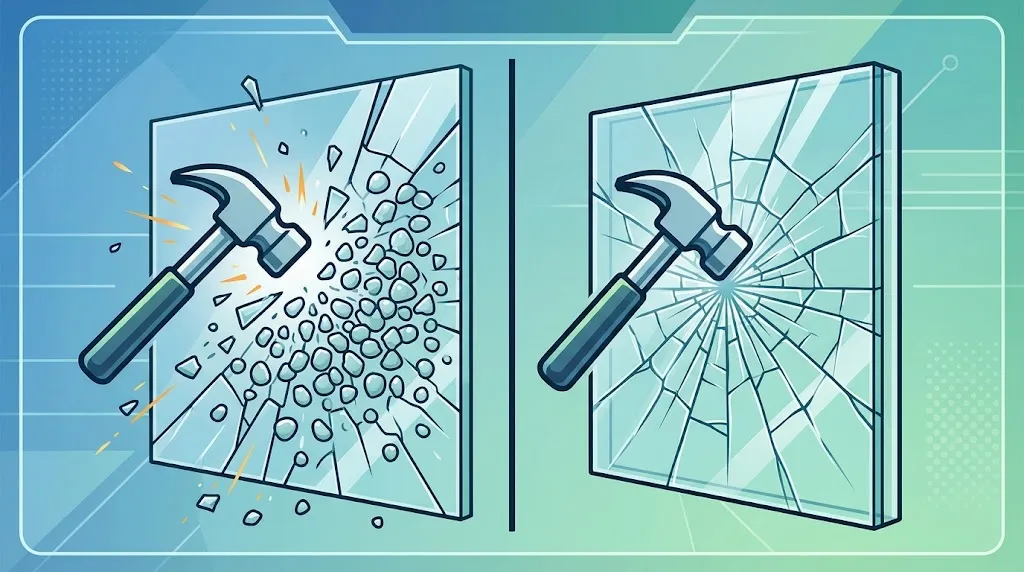
The answer depends on the type of risk you need to manage. Tempered glass is designed to provide increased mechanical strength and break into small, relatively blunt fragments. Laminated glass is designed to hold broken fragments together through an interlayer, helping reduce the risk of falling glass and maintaining a barrier after breakage.
For many demanding architectural applications, laminated glass—or laminated glass made with tempered glass plies—can offer a more comprehensive safety solution.
1. What Is Tempered Glass?
Tempered glass, also known as toughened glass, is manufactured by heating glass to a high temperature and then rapidly cooling it. This thermal treatment creates a compressive stress layer at the surface and tensile stress within the glass.
The resulting stress pattern improves the glass’s resistance to mechanical impact and temperature differences compared with ordinary annealed glass of the same thickness.
Key Benefits of Tempered Glass
- Increased strength: Properly manufactured tempered glass generally offers substantially greater resistance to bending and impact than comparable annealed glass.
- Safer breakage pattern: When it breaks, it typically fragments into many small pieces rather than large, sharp shards.
- Thermal resistance: It generally tolerates greater temperature differences than ordinary annealed glass.
- Design flexibility: It is suitable for a wide range of architectural applications, including doors, partitions, shower enclosures, and building facades.
Limitations of Tempered Glass
Tempered glass has one important limitation: when it breaks, the pane usually loses its integrity and no longer acts as a continuous barrier. The small fragments may fall out of the frame, creating an opening.
It also cannot normally be cut, drilled, or edge-worked after tempering. These operations must be completed before the heat-treatment process.
For applications where retaining glass fragments is critical, monolithic tempered glass may not provide sufficient protection on its own.
2. What Is Laminated Glass?
Laminated glass is produced by bonding two or more layers of glass together with an interlayer, commonly polyvinyl butyral (PVB), ethylene-vinyl acetate (EVA), or an ionoplast interlayer, depending on the product design and performance requirements.
When the glass cracks, the interlayer helps hold the fragments together. Depending on the glass construction, impact severity, framing system, and interlayer properties, the panel may remain in place and continue to provide a degree of separation after breakage.
Key Benefits of Laminated Glass
- Fragment retention: The interlayer helps keep broken glass pieces attached, reducing the risk of fragments falling from elevated glazing.
- Improved post-breakage performance: The assembly may continue to provide a barrier after cracking, although its remaining capacity must be evaluated for the intended application.
- Enhanced security potential: Specially designed laminated constructions can provide resistance to forced entry, ballistic threats, or other security risks when tested and specified for those purposes.
- Acoustic benefits: Suitable interlayers and glass configurations can help reduce sound transmission.
- Additional design options: Laminated glass can incorporate colored interlayers, decorative materials, and different glass types.
Limitations of Laminated Glass
Laminated glass is not automatically stronger than tempered glass in every respect. Its mechanical performance depends on the thickness and treatment of each glass ply, the interlayer, the overall construction, and the support conditions.
It may also cost more than a comparable monolithic tempered glass panel. Edge protection, sealant compatibility, fabrication quality, and moisture exposure are important considerations, particularly for exterior applications.
Most importantly, ordinary laminated glass should not automatically be described as bullet-resistant, burglar-resistant, or suitable for overhead protection. These applications require appropriate design, testing, and verification.
3. Tempered Glass vs. Laminated Glass: Key Differences
| Comparison | Tempered Glass | Laminated Glass |
|---|---|---|
| Basic construction | One heat-treated glass pane | Two or more glass plies bonded with an interlayer |
| Mechanical strength | Higher resistance to impact and bending than comparable annealed glass | Depends on glass plies, interlayer, and overall construction |
| Breakage pattern | Usually breaks into small fragments | Glass cracks while fragments tend to adhere to the interlayer |
| Fragment retention | Generally limited after breakage | A principal safety advantage |
| Post-breakage barrier | Usually lost when the pane fragments | May remain in place, depending on the system |
| Acoustic performance | Depends on thickness and glazing assembly | Can provide additional sound-reduction benefits |
| Security applications | Limited as a single pane after breakage | Special constructions can be designed for security |
| Typical applications | Doors, shower enclosures, partitions, and facade components | Guardrails, skylights, overhead glazing, security glazing, and selected facade systems |
The most important distinction is not simply which glass is stronger. It is how the glass behaves when it breaks and whether the glazing system needs to remain in place afterward.
4. Which Glass Is Safer for Different Applications?
The best choice depends on the location of the glass, the likelihood of human impact, the consequences of breakage, and the applicable building regulations.
Glass Doors and Shower Enclosures
Tempered safety glass is widely used for glass doors and shower enclosures because of its impact resistance and characteristic breakage pattern.
Both tempered and laminated glass can be used in curtain wall systems.
Tempered glass can be appropriate where strength, thermal performance, and the specified breakage characteristics meet the design requirements. Laminated glass is particularly relevant where fragment retention, protection against falling glass, or post-breakage performance is a priority.
For high-rise buildings and public spaces, the design team should consider wind loads, glass dimensions, support conditions, human safety, and the consequences of glass failure. In some projects, a laminated assembly containing tempered glass plies is the preferred solution.
Balustrades, Guardrails, and Glass Staircases
Laminated glass is often preferred for glass guardrails and balustrades because its interlayer can help retain fragments after breakage.
However, fragment retention alone does not establish that a railing is safe. The complete system must be designed for the required loads and verified for its intended use, including its post-breakage requirements where applicable.
Skylights and Overhead Glazing
Overhead glazing requires particular attention because broken glass can fall onto people below.
Laminated glass is often considered for these applications because the interlayer helps retain fragments. Depending on the project, the specification may require heat-treated glass plies, a particular interlayer, and defined post-breakage performance.
The appropriate solution must be established through the applicable building code and engineering design rather than by selecting a glass type in isolation.
Schools, Hospitals, and Public Buildings
In schools, hospitals, transportation facilities, and other public buildings, glass selection should account for accidental impact, occupant safety, maintenance, and the consequences of breakage.
Tempered glass may be suitable for many internal applications. Laminated glass may provide additional benefits where fragment retention or continued separation is particularly important.
5. Is Tempered Laminated Glass Better Than Either Option Alone?
In many applications, combining tempered glass with lamination provides a useful balance of mechanical strength and post-breakage fragment retention.
Tempered laminated glass consists of two or more tempered glass plies bonded with an interlayer.
It combines two distinct functions:
- Tempering improves the mechanical and thermal characteristics of each glass ply.
- Lamination helps retain fragments when the glass breaks.
This combination is commonly considered for demanding architectural applications, including curtain walls, overhead glazing, guardrails, and selected security glazing systems.
Nevertheless, combining these processes does not automatically guarantee compliance with every safety requirement. The glass thickness, interlayer type, support system, load conditions, and applicable test standards must all be considered.
For projects with particularly demanding requirements, the design team should specify the required performance of the complete glazing assembly.
6. Real-World Application: Tianhou Glass in Architectural Projects
Tianhou Glass provides architectural and safety glass solutions for commercial buildings, public infrastructure, and hospitality projects. Its project experience illustrates why glass specifications should be matched to the requirements of each building rather than based on a single material characteristic.
Zhuhai Mingzhu Station
Zhuhai Mingzhu Station is one example of Tianhou Glass’s architectural glass project experience. The project involved elevated railway station curtain walls and canopy glazing.
The specified glass included high-strength, ultra-clear tempered laminated glass, with PVB or SGP interlayers and Low-E insulating glass configurations used as required by the design.
This type of project demonstrates the importance of evaluating multiple performance requirements together, including glass strength, fragment retention, daylight transmission, thermal performance, and the demands of the building envelope.
The appropriate construction depends on the specific location and function of each glazed component.
Zhuhai Railway Station
Tianhou Glass has also supplied architectural glass for Zhuhai Railway Station, a major transport facility in Zhuhai, Guangdong, China.
The project included oversized double Low-E insulating laminated glass. This type of configuration can combine fragment retention with thermal-control performance, depending on the glass makeup and the insulating unit design.
These project examples highlight a key principle in architectural glass specification: safety, structural performance, and energy efficiency must be evaluated as related but distinct requirements.
Project specifications should be confirmed for the individual application, and the performance of a particular glass assembly should not be inferred solely from its product name.
7. Safety Standards and Technical Considerations
Selecting safety glass involves more than comparing product descriptions. Architects, facade consultants, contractors, and procurement teams should confirm the applicable standards for the project location.
In the United States, relevant requirements may include:
- ANSI Z97.1: A safety-glazing standard addressing the performance of glazing materials used in buildings.
- CPSC 16 CFR Part 1201: A federal safety standard covering specified architectural glazing products, including certain doors and shower enclosures.
- Applicable building codes: Requirements vary according to the glazing location, building type, and local jurisdiction.
For European projects, EN 12150-1 addresses characteristics of thermally toughened soda-lime silicate safety glass, while other applicable product and safety-glazing standards may govern laminated products and their intended uses.
Before ordering glass, confirm:
- The required safety-glazing classification and impact performance.
- The glass thickness, dimensions, and heat-treatment requirements.
- The interlayer material and thickness, where applicable.
- Wind loads, support conditions, and any structural requirements.
- The required post-breakage performance.
- The relevant product documentation, test evidence, and local code compliance.
Standards are not interchangeable, and compliance with one standard does not necessarily demonstrate compliance with another.
8. How to Choose the Right Safety Glass for Your Project
For a straightforward selection process, start with the main risk the glass needs to address.
Choose tempered glass when:
- Increased mechanical strength is a priority.
- A small-fragment breakage pattern is appropriate for the application.
- The glazing system does not require the same degree of post-breakage fragment retention as a laminated system.
- The product meets all applicable safety and building-code requirements.
Choose laminated glass when:
- Retaining broken glass is a key safety objective.
- The application involves guardrails, overhead glazing, or other locations where falling fragments present a concern.
- Additional acoustic or security performance is required from a suitably designed construction.
- The project requires a degree of barrier performance after glass breakage.
Consider tempered laminated glass when:
- The design requires both the benefits of heat-treated glass and fragment retention.
- The glazing system has demanding safety or structural requirements.
- The complete assembly can be designed and verified for the intended loads and post-breakage conditions.
For a reliable specification, consult the glass manufacturer and the project’s facade or structural engineer before finalizing the glass type.
Frequently Asked Questions
Is laminated glass stronger than tempered glass?
Not necessarily. Tempered glass generally has greater mechanical strength than comparable annealed glass, while laminated glass is distinguished by its interlayer and fragment-retention performance. The relative strength of a particular product depends on its construction and the type of load being considered.
Does tempered glass break more safely than ordinary glass?
Tempered glass generally breaks into many small fragments rather than the large, sharp shards associated with ordinary annealed glass. However, the fragments can still cause injuries, and the pane usually loses its integrity after breakage.
Can laminated glass break?
Yes. Laminated glass can crack or break under sufficient impact. Its interlayer helps hold fragments together, but the remaining integrity and barrier performance depend on the construction and impact conditions.
Is laminated glass suitable for high-rise buildings?
Yes, appropriately designed laminated glass is used in many high-rise building applications. The specification must account for facade loads, support conditions, glass retention, applicable safety requirements, and the consequences of breakage.
Can tempered glass be laminated?
Yes. Tempered glass can be laminated with compatible interlayer materials. This creates tempered laminated glass, which combines the characteristics of tempered glass plies with the fragment-retention benefits of lamination.
Which glass should I specify for a curtain wall project?
The choice depends on the facade design, building height, wind loads, safety requirements, thermal performance targets, and local regulations. Both tempered and laminated glass may be appropriate in different parts of the same building.
Conclusion: Safety Depends on the Right Glass Configuration
Tempered glass and laminated glass serve different but complementary purposes in architectural design.
Tempered glass offers increased mechanical strength and a characteristic small-fragment breakage pattern. Laminated glass helps retain broken fragments and may maintain a barrier after breakage. For projects that require both characteristics, tempered laminated glass can be an effective option when properly designed and specified.
For architects, contractors, developers, and glass distributors, the best approach is to define the performance requirements first and then select the appropriate glass construction.
Tianhou Glass supports architectural and safety glass applications with solutions for curtain walls, public buildings, transportation infrastructure, and commercial projects. Contact Tianhou Glass to discuss the glass specifications, processing requirements, and performance considerations for your next project.