
News & Insights
Why High-Performance Glass Is Becoming Standard in Modern Buildings
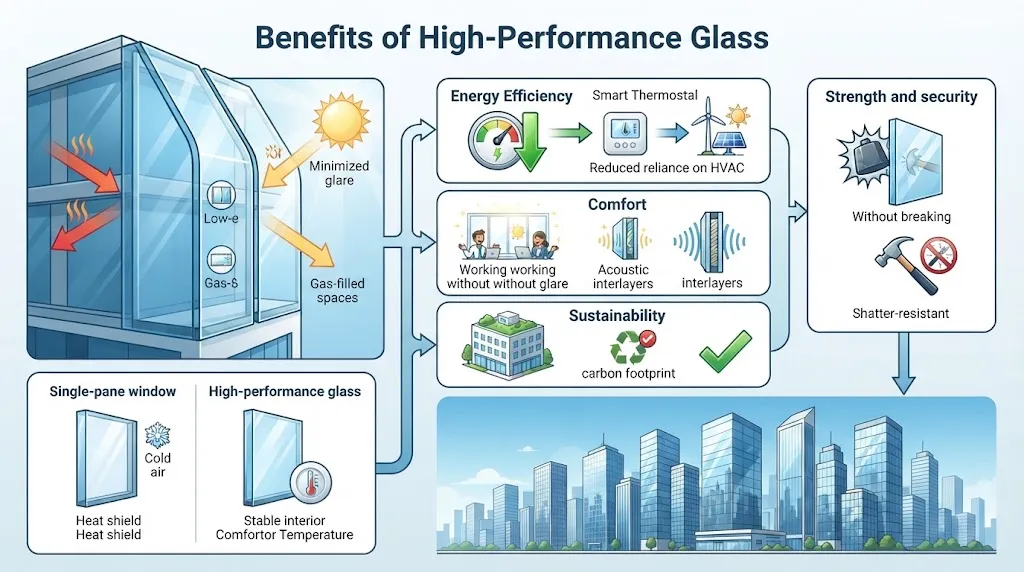
Modern buildings are expected to deliver more than an attractive appearance. Architects, developers, and construction companies increasingly need building materials that improve energy efficiency, indoor comfort, safety, and long-term performance. As a result, high-performance glass is becoming an important choice for modern architectural design.
From commercial office towers to residential developments, advanced glazing solutions help balance natural daylight, thermal insulation, solar control, and building safety.
1. Energy Efficiency Is Driving Demand
Windows and glass curtain walls form a significant part of a building’s exterior envelope. Unlike insulated walls, conventional glazing can allow substantial heat transfer, increasing the demand for air conditioning or heating.
According to the U.S. Department of Energy, windows account for approximately 10% of energy use in buildings. Improving window performance can therefore contribute to lower energy consumption and improved building efficiency.
High-performance glazing technologies include:
- Low-E glass: Special coatings help control heat transfer while allowing natural light to enter.
- Insulated glass units (IGUs): Two or more glass panes separated by a sealed cavity improve thermal insulation.
- Solar-control glass: Helps reduce unwanted solar heat gain, particularly in warm climates.
- Triple glazing: Adds another glass pane and insulating cavity to improve thermal performance where appropriate.
The best solution depends on the building’s climate, orientation, window system, and energy targets.
2. Better Indoor Comfort and Noise Reduction
High-performance glass can help maintain more stable indoor temperatures and reduce uncomfortable hot or cold areas near windows.
For buildings near busy roads, railway stations, or commercial districts, appropriately designed laminated or insulated glass systems can also improve acoustic performance. The actual noise reduction depends on glass thickness, pane combinations, cavity design, frame construction, and installation quality.
For residential developments, hotels, offices, and educational facilities, these benefits can contribute to a more comfortable indoor environment.
3. Safety and Durability Matter
Modern architectural projects must consider more than thermal performance. Glass may also need to meet specific requirements for impact resistance, wind loads, human safety, and security.
Different glass technologies address different needs:
- Tempered glass: Offers increased mechanical and thermal resistance compared with ordinary annealed glass and breaks into relatively small fragments when it fails.
- Laminated glass: Uses an interlayer to help retain broken fragments and maintain a barrier after breakage.
- Insulated laminated glass: Combines thermal insulation with selected safety and acoustic benefits.
- Fire-rated glass: Designed and tested for specified fire-resistance performance in approved systems.
Product selection should follow applicable building codes, project specifications, and verified test results. No single glass type provides every performance benefit.
4. Sustainable Design Is Changing Glass Specifications
Energy-efficient building materials are increasingly important to developers seeking to reduce operational energy consumption and meet sustainability targets.
The International Energy Agency identifies buildings as a major part of global energy demand and emissions. Improving the performance of the building envelope is one way to support broader energy-efficiency goals.
High-performance glass can contribute by reducing unwanted heat gain or loss while preserving daylight and outdoor views. However, the overall result depends on the complete building design, including insulation, shading, HVAC systems, and installation quality.
For architects and developers, the objective is not simply to select the most advanced glass. It is to specify a glazing system that achieves the right balance of performance, appearance, safety, and cost.
5. Tianhou Glass: Supporting Modern Architectural Projects
As an architectural and safety glass manufacturer based in Zhuhai, Guangdong, Tianhou Glass provides glass processing solutions for modern construction projects.
Its product range includes Low-E glass, insulated glass, laminated glass, tempered glass, curtain wall glass, and other customized glazing products.
For example, Tianhou Glass supplied double-silver Low-E insulating laminated curtain wall glass for the Fushan Smart Manufacturing Town project. The project involved approximately 103,657 square metres of curtain wall glazing, illustrating the scale of glass requirements in modern industrial developments.
This type of application highlights why glass specification and processing quality matter in large projects. The appropriate combination of coating, glass layers, interlayers, and insulating cavities must be selected according to the project’s thermal, structural, safety, and visual requirements.
For international buyers, working directly with a glass processing manufacturer can also support customized specifications and project-specific supply coordination.
6. How to Choose High-Performance Glass
Before specifying glass for a building, architects, contractors, and procurement teams should evaluate several key factors:
- Thermal performance: Check the U-factor or U-value and the solar heat gain coefficient (SHGC), using the applicable rating system.
- Daylight and appearance: Consider visible light transmittance, reflectivity, colour, and façade design.
- Safety requirements: Select tempered, laminated, fire-rated, or other suitable glass according to the intended application.
- Acoustic performance: Assess the complete glazing and framing system where noise control is important.
- Manufacturing and quality control: Confirm dimensional tolerances, coating requirements, edge processing, testing, and relevant certifications.
- Installation and lifecycle cost: Consider the complete window or curtain wall system rather than evaluating the glass pane alone.
In hot climates such as southern China and Southeast Asia, solar heat gain control and air-conditioning efficiency are often important priorities. Low-E insulated glass may be a suitable option, depending on the project’s daylight requirements and performance targets.
Conclusion
High-performance glass is becoming increasingly important in modern buildings because it can help improve energy efficiency, indoor comfort, acoustic performance, and safety while supporting contemporary architectural design.
The key is to select the right glazing configuration for each application rather than treating all advanced glass products as interchangeable.
With architectural glass processing capabilities and project-oriented customization, Tianhou Glass supports developers, contractors, and international buyers seeking glazing solutions for commercial, residential, and industrial buildings.
Looking for a high-performance glass solution for your next project? Contact Tianhou Glass to discuss your project requirements, glass specifications, and customized architectural glazing options.