
News & Insights
How Glass Tempering Improves Strength and Thermal Resistance
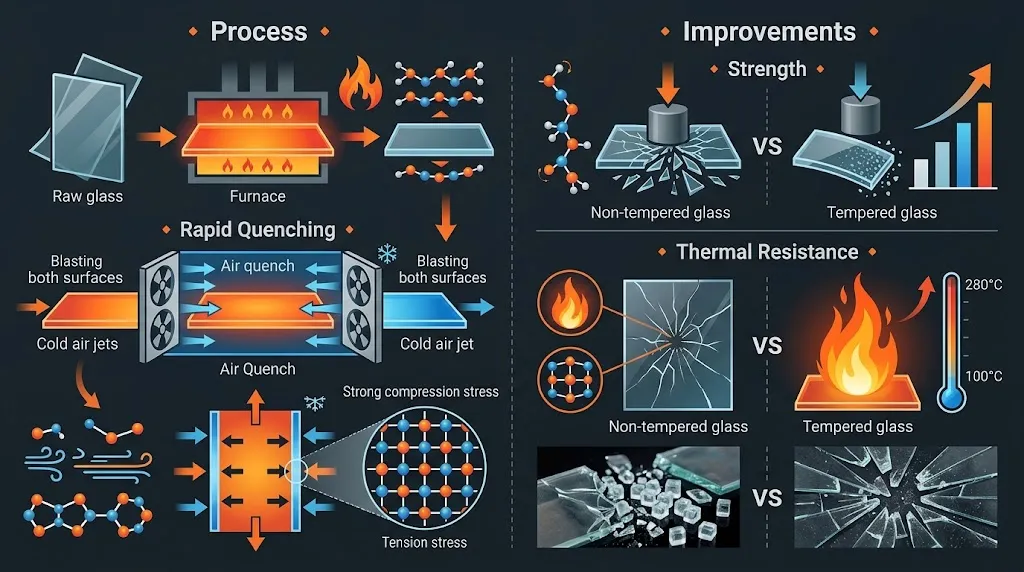
Glass is widely used in modern building façades, doors, windows, partitions, and balustrades. However, ordinary annealed glass may not provide sufficient resistance to mechanical loads or temperature differences in demanding architectural applications. Glass tempering improves these properties through a controlled heating and rapid cooling process, making tempered glass a reliable option for many building projects.
What Is Glass Tempering?
Glass tempering, also known as thermal toughening, involves heating prepared glass to a high temperature and rapidly cooling its surfaces with air. This process creates compressive stress at the glass surfaces and balancing tensile stress inside the glass.
The resulting stress profile improves the glass’s resistance to mechanical loading and thermal stress. Fully tempered glass is commonly described as approximately four times as strong as annealed glass of the same thickness under comparable conditions, although actual performance depends on glass quality, dimensions, edge condition, loading, and test method.
How Tempering Improves Glass Strength
The surface compression created during tempering helps resist the formation and growth of cracks caused by external forces. This makes tempered glass suitable for applications where greater strength is required, including:
- Building curtain walls and façade systems
- Glass doors and windows
- Shower enclosures and interior partitions
- Glass railings and balustrades
- Commercial buildings and public facilities
Fully tempered glass also has a safer breakage pattern than ordinary annealed glass. When it breaks, it generally fragments into relatively small pieces, reducing the likelihood of severe cutting injuries. However, tempered glass is not unbreakable, and safety performance must be evaluated against the applicable building codes and glazing standards.
Why Tempered Glass Has Better Thermal Resistance
Glass can experience thermal stress when different areas of a pane heat or cool at different rates. This can occur because of direct sunlight, shadows, heating systems, or differences in temperature between the center and edges of the glass.
Tempering improves resistance to these thermal stresses by introducing surface compression. This helps the glass withstand greater temperature-related stress than comparable annealed glass.
Nevertheless, thermal performance depends on several factors, including glass thickness, edge quality, glazing design, coatings, installation conditions, and the temperature difference across the pane. Tempered glass should not be treated as completely resistant to thermal shock or unlimited operating temperatures.
How Tianhou Glass Supports Architectural Projects
Tianhou Glass provides architectural glass processing solutions for projects that require a balance of strength, safety, appearance, and thermal performance.
For example, Tianhou Glass has supplied high-performance glazing for hotel projects in Macau, including insulated glass units combining Low-E coatings with tempered and laminated glass. These configurations demonstrate how tempered glass can form part of a wider glazing system designed to address structural, energy-efficiency, and safety requirements.
For curtain walls, doors, windows, and other architectural applications, the appropriate glass specification should be determined according to the project design, wind loads, thermal conditions, safety requirements, and installation method. Tempered glass may also be combined with laminated or insulated glass to meet additional project objectives.
What Should Buyers Consider When Specifying Tempered Glass?
Before ordering tempered glass, architects, contractors, and procurement teams should confirm:
- Glass type, thickness, dimensions, and applicable tolerances
- Required edge finishing, holes, notches, and cutouts
- Mechanical loads and thermal-stress conditions
- Whether laminated or insulated construction is required
- Applicable standards, testing, and quality documentation
All required cutting, drilling, notching, and edge processing must be completed before tempering because tempered glass generally cannot be cut or drilled afterward without breaking.
Conclusion
Glass tempering improves mechanical strength and resistance to thermal stress through a carefully controlled manufacturing process. When correctly specified and fabricated, tempered glass can help meet the performance requirements of modern architectural glazing.
Tianhou Glass supports architectural and commercial projects with customized glass processing and glazing solutions. Contact Tianhou Glass to discuss glass specifications for your next building project.