
News & Insights
Low-Iron Glass: Applications and Performance
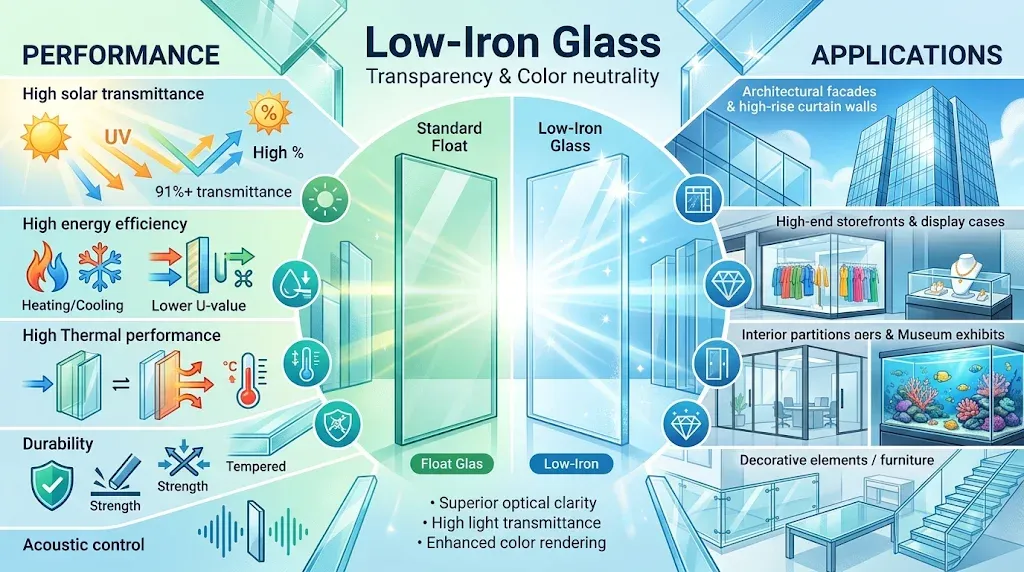
Low-iron glass is a premium type of float glass designed to provide higher light transmission and greater visual clarity than standard clear glass. By reducing the iron oxide content in the glass composition, manufacturers can significantly reduce the characteristic green tint, especially noticeable along the edges of thick glass panels.
For modern architectural projects, low-iron glass is an excellent choice when transparency, natural light, and accurate colour presentation are important.
1. What Is Low-Iron Glass?
Standard clear float glass naturally contains small amounts of iron oxide, which give the glass a subtle green appearance. This colour becomes more noticeable as glass thickness increases.
Low-iron glass is manufactured using carefully selected raw materials with lower iron content. This reduces the green tint and creates a clearer, more neutral appearance.
Compared with standard clear glass, low-iron glass offers several advantages:
- Higher light transmission: Allows more natural daylight to enter buildings.
- Improved colour neutrality: Displays objects and architectural materials with less green colour distortion.
- Better edge clarity: Reduces the green appearance visible along exposed glass edges.
- Enhanced transparency: Creates a cleaner visual effect for applications requiring high clarity.
Low-iron glass is available for further processing, including tempering, lamination, insulating glass production, and other customised architectural applications.
2. Main Applications of Low-Iron Glass
Low-iron glass is widely used in projects where visual quality and transparency are essential.
Architectural Facades and Curtain Walls
Low-iron glass is particularly suitable for curtain walls with large transparent areas, glass entrances, atriums, and architectural features where the natural appearance of the building materials needs to remain visible.
For buildings with extensive glazing, low-iron glass helps create a brighter and more visually consistent facade. It is also a good option for frameless designs where exposed glass edges are part of the architectural appearance.
Interior Partitions and Glass Doors
Low-iron glass provides a clean, modern appearance for office partitions, glass doors, meeting rooms, and residential interiors.
Its neutral colour makes it easier to maintain visual consistency between different glass panels, especially in spaces with abundant natural light.
Showcases and Retail Displays
Retail stores, jewellery showcases, museums, and exhibition spaces often require glass that does not noticeably alter the colours of displayed objects.
Low-iron glass provides excellent colour neutrality and transparency, helping products and exhibits appear closer to their natural colours.
Glass Balustrades and Decorative Applications
Low-iron glass is also suitable for stair railings, balconies, glass handrails, furniture, tabletops, and decorative installations.
When tempered or laminated, it can be manufactured into safety glazing configurations according to the project’s structural and safety requirements.
3. Performance of Low-Iron Glass
One of the most important performance indicators is visible light transmittance (VLT), which measures the percentage of visible light passing through the glass.
For reference, typical 6 mm standard clear float glass has visible light transmittance of approximately 89%, while many 6 mm low-iron products achieve around 90–91%. Actual values depend on the manufacturer and product specification.
Other important considerations include:
- Optical clarity: Low-iron glass reduces the green colour cast and improves visual transparency.
- Colour consistency: It provides a more neutral background for architectural finishes, printed patterns, and decorative materials.
- Solar performance: Higher visible light transmission does not automatically mean better solar heat insulation. Solar heat gain should be evaluated separately.
- Processing compatibility: Low-iron glass can be further processed into tempered glass, laminated glass, and insulating glass units, subject to the manufacturer’s specifications.
For projects requiring energy efficiency, low-iron glass can also be combined with suitable Low-E coatings and insulating glass configurations to balance daylight, solar heat gain, and thermal insulation.
4. How to Select the Right Low-Iron Glass
Selecting low-iron glass requires more than simply choosing a transparent material. Architects, contractors, and glass suppliers should consider several factors:
- Glass thickness: The required thickness depends on panel dimensions, wind loads, support conditions, and applicable building regulations.
- Safety requirements: Tempered or laminated configurations may be necessary for overhead glazing, balustrades, doors, and other safety-critical applications.
- Thermal performance: Consider Low-E coatings, insulating glass configurations, and solar heat gain requirements.
- Visual consistency: For large projects, colour consistency between panels and exposed edges should be evaluated.
- Processing requirements: Confirm that the selected glass is suitable for cutting, tempering, drilling, edging, lamination, or insulating glass production.
A professional glass supplier should evaluate these requirements before confirming the final glass specification.
5. Tianhou Glass: Low-Iron Glass Solutions for Architectural Projects
Based in Zhuhai, Guangdong, Guangdong Tianhou Glass Engineering Co., Ltd. provides architectural glass processing and project-oriented glass solutions for customers across the Greater Bay Area and other markets.
With approximately 20,000 square metres of manufacturing facilities and experience in architectural and safety glass, Tianhou Glass supports projects involving curtain walls, building doors and windows, laminated glass, tempered glass, insulating glass, and customised glass processing.
In projects such as commercial building facades, educational facilities, and transportation infrastructure, glass clarity, safety, dimensional accuracy, and processing quality are important considerations.
For projects requiring a cleaner and more neutral appearance, Tianhou Glass can assist customers in evaluating low-iron glass specifications and suitable further-processing options.
Depending on project requirements, solutions can include:
- Low-iron tempered glass
- Low-iron laminated glass
- Low-iron insulating glass
- Custom-sized architectural glass
- Combined Low-E and insulating glass solutions
By considering glass performance, processing requirements, and installation conditions together, Tianhou Glass helps customers select glazing solutions that meet both architectural and functional expectations.
6. Conclusion
Low-iron glass is an excellent choice for architectural applications where transparency, natural light, and colour accuracy are priorities.
From curtain walls and glass entrances to retail displays and decorative installations, its reduced green tint creates a cleaner and more refined visual appearance.
However, the best glass specification depends on the project’s structural, safety, and energy-efficiency requirements.
Tianhou Glass provides professional architectural glass processing and customised solutions to support construction projects seeking reliable glass quality and refined visual performance.