
News & Insights
What Makes Laminated Glass Safer Than Monolithic Glass?
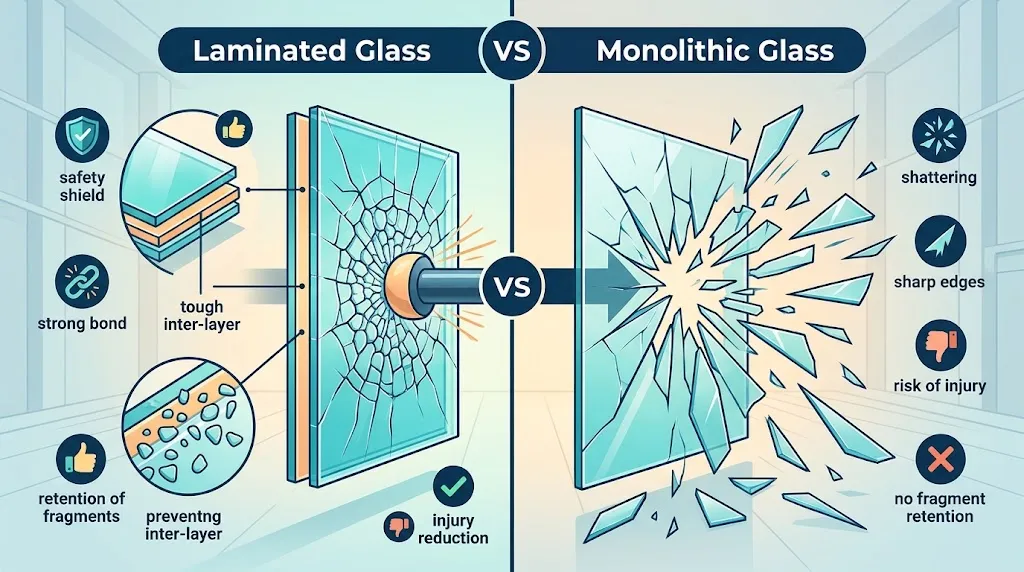
Glass is widely used in modern architecture, from windows and curtain walls to doors, skylights, and balustrades. However, when glass breaks, the way it fractures can have a significant impact on building safety. This is one of the main reasons architects and developers choose laminated glass over conventional monolithic glass for safety-critical applications.
1. What Is the Difference Between Laminated Glass and Monolithic Glass?
Monolithic glass is a single sheet of glass. Depending on its manufacturing process, it may be annealed, heat-strengthened, or tempered. Its strength and fracture behavior vary according to the glass type.
Laminated glass consists of two or more glass panes bonded together with an interlayer, commonly polyvinyl butyral (PVB). Heat and pressure are used to create a bonded composite structure.
The key difference is how the materials behave after breakage. Conventional monolithic glass may leave an opening or release dangerous fragments, depending on its type. Laminated glass is designed to hold broken fragments together through its interlayer, helping reduce the risk of injury.
2. Three Safety Advantages of Laminated Glass
Retains Broken Glass Fragments
The primary safety advantage of laminated glass is its interlayer. When the glass cracks, fragments can remain attached to the interlayer rather than falling freely. This helps reduce the risk of cuts and injuries caused by falling glass.
Helps Maintain a Barrier After Breakage
Even when one or both glass panes fracture, the interlayer can help the laminated unit remain in the frame. Depending on the glass construction, impact severity, and installation system, this can delay penetration and provide additional protection while replacement is arranged.
Supports Security and Acoustic Performance
Laminated glass can be designed for more than basic safety. With suitable glass thicknesses and interlayer configurations, it can provide improved resistance to penetration, help reduce noise transmission, and offer other functional benefits.
However, bullet resistance, blast resistance, and other specialized security performances require specifically engineered and tested glass assemblies. Standard laminated glass should not automatically be considered bullet-resistant or high-security glazing.
3. Laminated Glass vs. Monolithic Glass: A Quick Comparison
| Feature | Laminated Glass | Monolithic Glass |
|---|---|---|
| Construction | Two or more glass panes with an interlayer | One glass pane |
| Behavior when broken | Interlayer helps retain fragments | Depends on glass type and treatment |
| Risk of falling fragments | Generally reduced | Varies by glass type |
| Post-breakage barrier | May remain in place | Depends on fracture pattern and installation |
| Acoustic performance | Can be enhanced with suitable interlayers | Depends on glass thickness and configuration |
| Security applications | Can be engineered for specific security requirements | Generally more limited |
An important distinction: tempered monolithic glass is stronger against impact than ordinary annealed glass of comparable thickness and typically breaks into small fragments. Laminated glass offers a different safety advantage by helping retain those fragments. For some applications, combining tempered glass with a laminated construction can provide both benefits.
4. Where Should Laminated Safety Glass Be Used?
Laminated glass is commonly considered for applications where falling fragments, impact safety, or post-breakage integrity are important, including:
- Glass balustrades and railings: Help retain broken fragments and reduce the risk of falling glass.
- Doors and floor-to-ceiling glazing: Reduce the risk associated with accidental human impact.
- Skylights and overhead glazing: Help prevent broken glass from falling freely, subject to the required glass configuration.
- Commercial storefronts: Provide safety benefits and can offer additional resistance to penetration.
- Architectural curtain walls: Can be specified where occupant safety, façade design, and project requirements call for laminated glazing.
The appropriate glass composition must be determined according to the application, local building codes, impact requirements, support conditions, and relevant testing standards.
5. How Tianhou Glass Supports Safer Architectural Glazing
Tianhou Glass is a glass deep-processing manufacturer based in Zhuhai, Guangdong, China, serving architectural and safety glass applications.
For architects, contractors, developers, and glass distributors, selecting the right glass involves more than choosing a thickness. It requires matching the glass construction, interlayer, dimensions, support system, and required safety performance to the intended application.
Tianhou Glass provides architectural glass processing solutions, including laminated glass and other glass products for building projects. By evaluating project requirements at the specification stage, buyers can identify suitable glass configurations for windows, curtain walls, doors, and other applications where safety is a priority.
For project-specific requirements, the glass composition and performance should be confirmed against applicable standards and technical documentation.
Conclusion
Laminated glass is often safer than conventional monolithic glass because its interlayer helps hold broken fragments together, reducing the risk of falling glass and helping preserve a barrier after breakage. While tempered monolithic glass offers its own important safety advantages, laminated glass is particularly valuable when post-breakage fragment retention is essential.
For architectural projects, choosing the right solution depends on the building’s intended use, applicable safety standards, and installation design. Tianhou Glass helps customers explore architectural glass processing options to meet these project-specific requirements.